Thailand Pushes WTO Reform, SME Finance Access at IMF Meetings
Thailand’s Deputy Prime Minister and Commerce Minister Supachai Sutthamphan met WTO Director-General Ngozi Okonjo-Iweala at the IMF–World Bank Annual Meetings in Bangkok to discuss WTO reform, digital trade, export diversification, and boosting SME access to finance and global markets. Both leaders emphasized the need for Thailand to raise domestic value addition, upgrade workforce skills, and expand free trade agreements to reduce reliance on any single market.
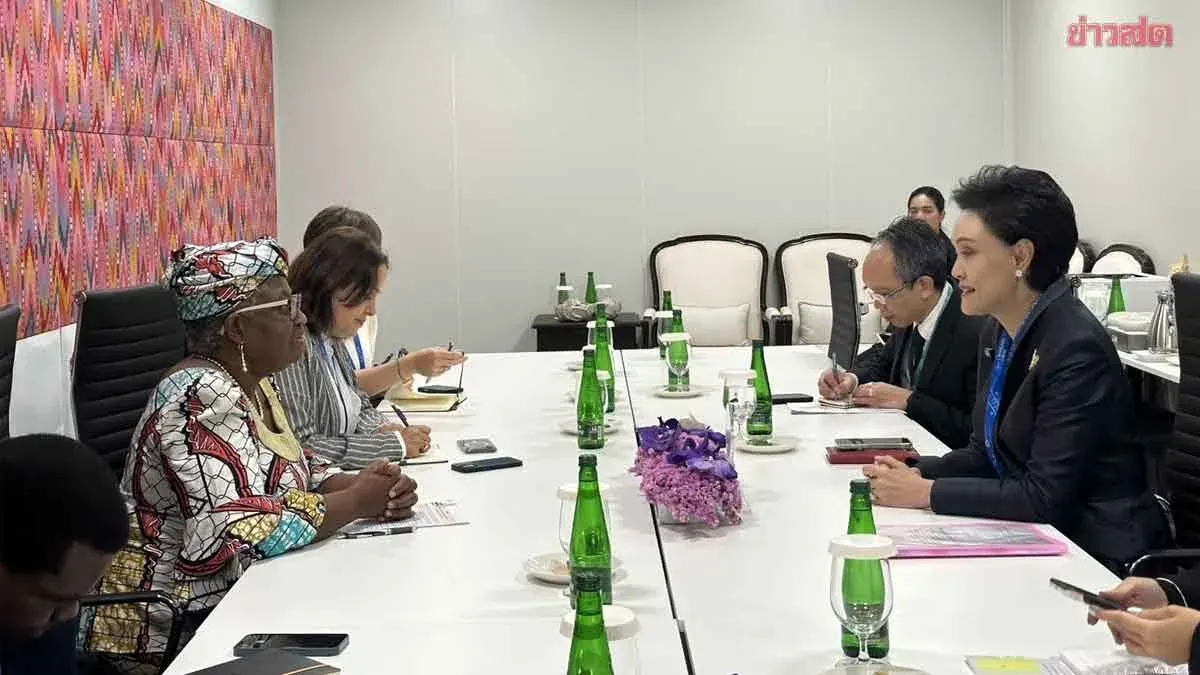
Deputy Prime Minister and Commerce Minister Supachai Sutthamphan revealed that on October 16, 2026, she held bilateral discussions with Dr. Ngozi Okonjo-Iweala, Director-General of the World Trade Organization (WTO), on the occasion of the Director-General’s visit for the 2026 IMF–World Bank Group Annual Meetings held in Thailand from October 12–18. The two exchanged views on the global trade situation, enhancing Thailand’s competitiveness, diversifying export markets, promoting SMEs, digital trade, and WTO reform.
Supachai noted that although Thailand’s exports expanded by 18.9 percent in the first eight months of 2026, driven mainly by the semiconductor and AI technology sectors, the country must accelerate domestic value addition, reduce reliance on imported raw materials and components, and upgrade labor skills so that Thai industry can capture more value from global supply chains. SMEs currently account for only about 12–14 percent of export value.
She added that amid geopolitical uncertainty, Thailand continues to prioritize market diversification through free trade agreement (FTA) negotiations, including an FTA with the European Union, deepening the Comprehensive Economic Partnership Agreement (CEPA) with the United Arab Emirates, and trade talks with the United States, to safeguard competitiveness and expand trade and investment opportunities while supporting the multilateral trading system under the WTO.
The WTO Director-General praised Thailand’s diversified economic structure spanning agriculture, industry, and services, and endorsed Thailand’s export market and supply chain diversification strategy. She observed that FTAs help reduce dependence on any single market and can coexist with the multilateral system, and she encouraged Thailand to upgrade domestic production and value addition through measures consistent with WTO rules.
Supachai outlined three government pillars for upgrading SMEs: developing skills and competitiveness, increasing access to finance, and expanding overseas markets. Initiatives include promoting business, financial, and digital technology knowledge; using intellectual property as collateral for financing (IP Financing); and helping SMEs leverage FTAs through knowledge sharing and business matching so smaller firms can access international trade opportunities. On this point, the WTO Director-General suggested Thailand explore cooperation on trade finance and supply chain finance to improve SME working capital access, and pointed to the International Finance Corporation (IFC), a World Bank Group member with expertise in this area. The WTO also expressed readiness to collaborate on education and capacity building for Thai entrepreneurs to enhance financing access and resilience.
Regarding digital trade, Supachai highlighted Thailand’s role in driving negotiations on a digital trade framework...