Thailand's Hazardous Waste Surges 40% to 1.5 Million Tons
Thailand's hazardous waste has surged 40% to 1.5 million tons annually, according to a new NESDC report. While total industrial waste averages 24.5 million tons per year, illegal dumping remains rampant with 382 cases documented since 2017. Regulatory gaps — including high disposal costs versus low fines and incomplete waste tracking — continue to enable environmental violations, with recent hydrocarbon contamination found near a waste pond in Prachinburi.
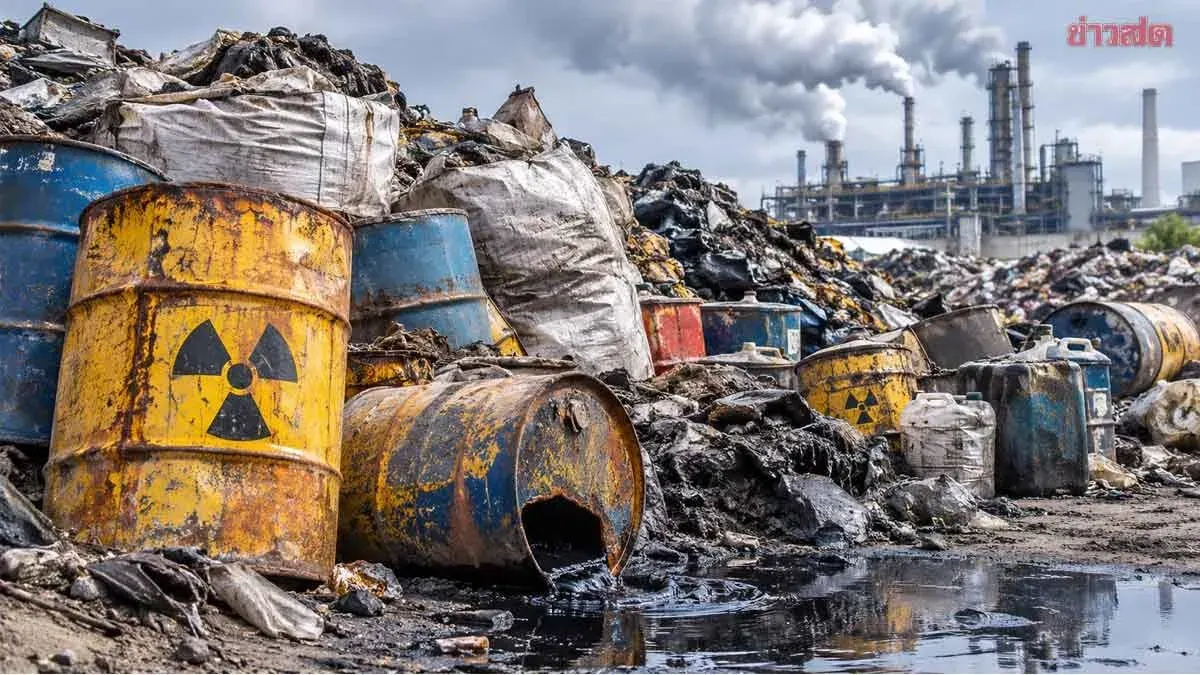
NESDC Secretary-General Danucha Pichayanan disclosed the Q3 2026 Thai Social Outlook report on "Industrial Waste: From Factory Waste to Social Costs." Economic growth, particularly new special economic zones and industrial estates, has generated an average 24.5 million tons of industrial waste annually from 2016-2025, mostly non-hazardous. However, hazardous waste increased 40.8% from roughly 1.1 million tons in 2016 to 1.5 million tons in 2025, partly due to improved reporting coverage. Illegal dumping continues unabated; the Bua Niwet Foundation documented 382 cases from 2017-2025, predominantly wastewater discharge in the Eastern region. In October 2026, the Pollution Control Department detected high hydrocarbon levels in water near an industrial waste pond in Prachinburi, adjacent to agricultural land and community fish farms.
Danucha explained that Thai waste management falls under multiple laws and agencies: the Department of Industrial Works oversees waste generators and handlers under the Factory Act B.E. 2535 and the 2023 Ministry of Industry notification on hazardous waste management, applying the Polluter Pays Principle. Hazardous substances fall under the Hazardous Substances Act B.E. 2535, with the Department of Land Transport regulating road transport. The Basel Convention governs cross-border waste movement, with Industrial Works permitting and Customs inspecting at borders. The Pollution Control Department, Department of Health, and local administrations handle pollution control, impact assessment, and public health.
Despite this legal framework, persistent illegal dumping reveals four critical regulatory gaps: 1. High disposal costs but low penalties incentivize dumping. Proper hazardous waste treatment costs 4,000-150,000 baht/ton (excluding transport), while Factory Act violations carry maximum fines of only 200,000 baht. When savings from illegal dumping exceed penalties and detection risk, generators choose cheap unlicensed handlers. A one-year statute of limitations also risks cases expiring before prosecution. 2. Waste tracking doesn't cover the full chain. The E-Fully Manifest system tracks transport trucks via real-time GPS but doesn't cover...