PSU Hosts Forum on US-Thailand Education Partnership
Prince of Songkla University's Pattani campus hosted a forum on U.S.-Thailand education partnership featuring the U.S. Embassy's public affairs counselor. The event highlighted decades of collaboration and outlined four priority areas for future cooperation, including AI skills, English proficiency, joint research, and industry linkages.
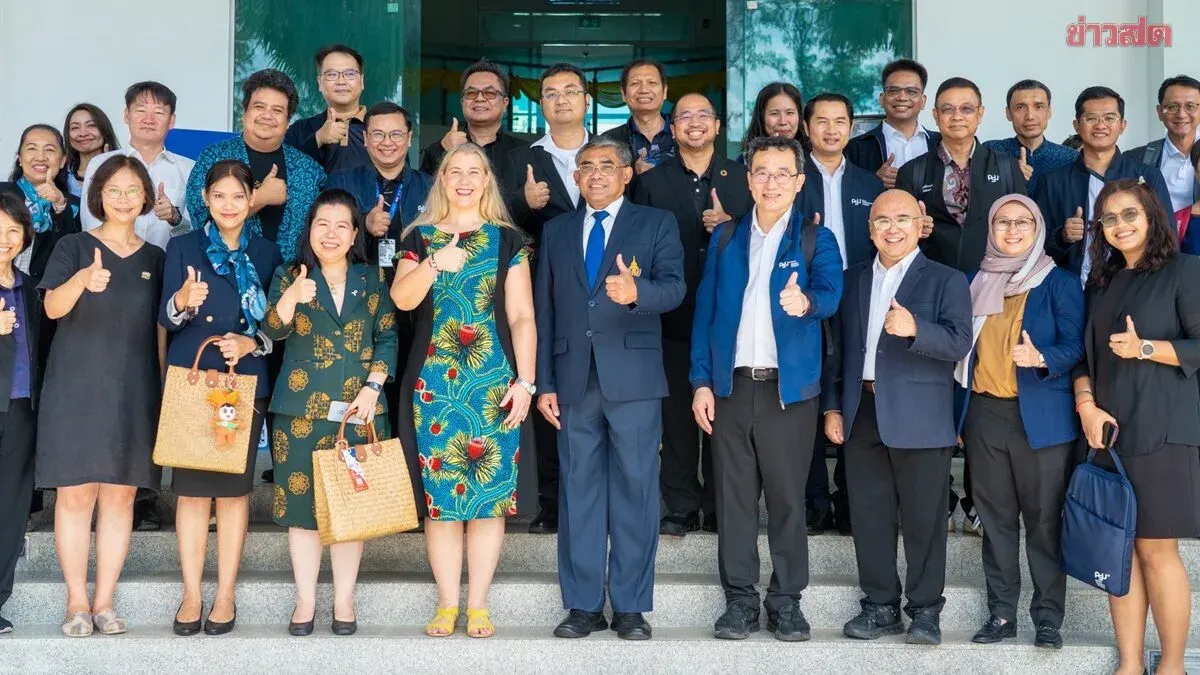
Prince of Songkla University's ASEAN Studies Center, led by Dr. Thanath Komol, organized the 12th Thanath Komol Lecture on "United States – Thailand Partnership in Education," with Ms. Deborah MacLean, Counselor for Public Affairs at the U.S. Embassy in Bangkok, as keynote speaker to exchange views and set directions for Thai-U.S. cooperation in education, research, and human resource development to meet global changes.
At the same time, the Pattani campus held booths displaying and selling products from 12 faculties and units to promote university achievements and products on the first floor of the Pattani Campus Administration Building during the University Council meeting, with Asst. Prof. Dr. Niwat Kaewpradap, President of Prince of Songkla University, and council members in attendance.
In his welcoming remarks, President Niwat emphasized the long-standing relationship between the university and the United States, which began in 1972 with the establishment of the John F. Kennedy Library at the Pattani campus — Thailand's first. This cooperation has expanded through programs such as the American Corner, Fulbright scholarships, Global UGRAD, and ongoing educational and knowledge exchange initiatives.
Ms. Deborah MacLean praised the cooperation between the U.S. Embassy and Prince of Songkla University, particularly the successful American Fair in Hat Yai, which provided opportunities for citizens, students, and personnel from both countries to learn about each other's cultures, exchange experiences, and foster mutual understanding. She noted that choosing PSU as the venue aimed to strengthen regional educational cooperation.
For future cooperation, the keynote speaker proposed four key areas: 1) Developing artificial intelligence (AI) and emerging technology skills by promoting staff training and joint curriculum development with U.S. institutions; 2) Enhancing English language skills to increase access to knowledge, research, and international academic networks; 3) Promoting joint research and innovation, especially in AI, cybersecurity, biotechnology, public health, and creative economy; and 4) Linking universities with industry to develop workforce skills, technology transfer, and research commercialization.
She also mentioned the International Academic Partnership Program, a collaboration between the U.S. Embassy, the Ministry of Higher Education, Science, Research and Innovation, and the private sector, linking higher education institutions of both countries through strategic planning, human resource development, and building STEM technology and digital economy cooperation networks, with PSU as a participating institution.
Ms. MacLean emphasized that university cooperation should not be limited to memoranda of understanding (MOUs) or student exchanges alone, but should develop into continuous programs with clear goals and measurable outcomes.