Nonthaburi Candidate Unveils Matrix Master Governance System
Independent candidate Dr. Prab Thamm Paktbua for Nonthaburi governor unveiled a "Matrix Master" governance system that manages the province by connecting data across six dimensions rather than handling problems through separate departments,
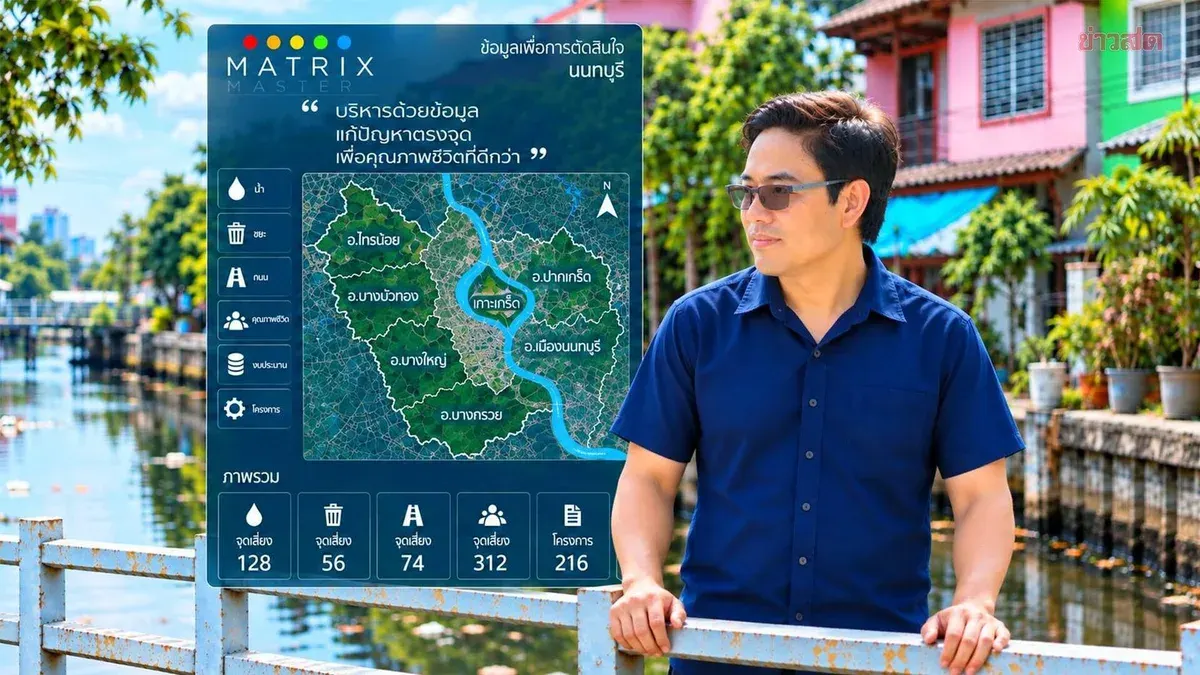
After progressively releasing proposals on flooding, waste, transportation, economy, quality of life, education, and oversight systems, Dr. Prab Thamm Paktbua, independent candidate number 6 for Nonthaburi Provincial Administration Organization governor, unveiled the "Matrix Master" framework. The system proposes managing the province by connecting data across all dimensions—"seeing the whole province"—rather than solving problems through separate projects.
Dr. Prab emphasized that real life for Nonthaburi residents does not divide problems by department or agency. One family may face flooding, transportation difficulties, income constraints, waste, and service access gaps simultaneously. Management must recognize these interconnections: where the problem lies, who is affected, who is responsible, the budget required, and the final outcome.
"Matrix doesn't start by asking what new projects we should add, but by asking what problems Nonthaburi residents face, who is responsible, what is needed to solve them, how much budget is required, and ultimately what residents gain."
Matrix Master connects management across six dimensions: M—Management & Local Economy; A—Accessibility & People; T—Technology; R—Resilience (water and crisis readiness); I—Infrastructure & Environment; and X—X-RAY & Transparency.
The core principle is not having six separate policy sets, but making all six dimensions "work together." For example, if an area experiences repeated flooding, the response should not simply add pumps but examine root causes by connecting water data, inspecting canals, water gates, pumps, and drainage systems; identifying responsible agencies; prioritizing budgets; and determining which populations are affected. Similarly, elderly residents struggling to reach hospitals face not just health issues but interconnected problems involving transportation, service access, information, and agency coordination. "Use what exists first, connect what we have, fill only what is missing," Dr. Prab proposed. Management should not always start by creating new projects but must first audit existing budgets, personnel, systems, services, and infrastructure, then connect what exists and add only missing components.
On the economy front, the system connects communities, entrepreneurs, farmers, traditional markets, local goods, and tourism. On transportation, it links rail, road, and water services, filling gaps in underserved areas. For waste management, the emphasis is on reducing new waste sent to landfills and recovering resources for reuse. Technology is positioned as a "tool, not the hero"—used to connect data, eliminate duplicate work, simplify service delivery, and track outcomes from problem identification through results, rather than starting with technology purchases or new apps.
Under X-RAY & Transparency, when Nonthaburi residents submit requests, they should not receive only "acknowledged" but should know who is responsible, the timeline, the current step, and the final result. Budget and publicly available information should be linked from appropriation through procurement, contracts, progress, inspections, and outcomes, showing how money is spent, where work stands, and what residents ultimately receive—following the principle "track everything, audit every baht."
Dr. Prab summarized Matrix Master as a single pathway covering problem identification, affected populations, responsible parties, budget, implementation, measurement, and public oversight.
"I don't want Nonthaburi to have the most policy names, but rather to make what exists work together. Every issue must show who is responsible, how much budget is used, how far work has progressed, and ultimately what Nonthaburi residents gain."
Matrix Nonthaburi—"Six dimensions, one system, measurable results."