Thailand Partners With UK and UN on Farm Climate Resilience
Thailand, the UK, and UN Food and Agriculture Organization are partnering to help farmers adapt to climate change, with focus on protecting millions of acres of rice paddies and cropland from increasing droughts and floods.
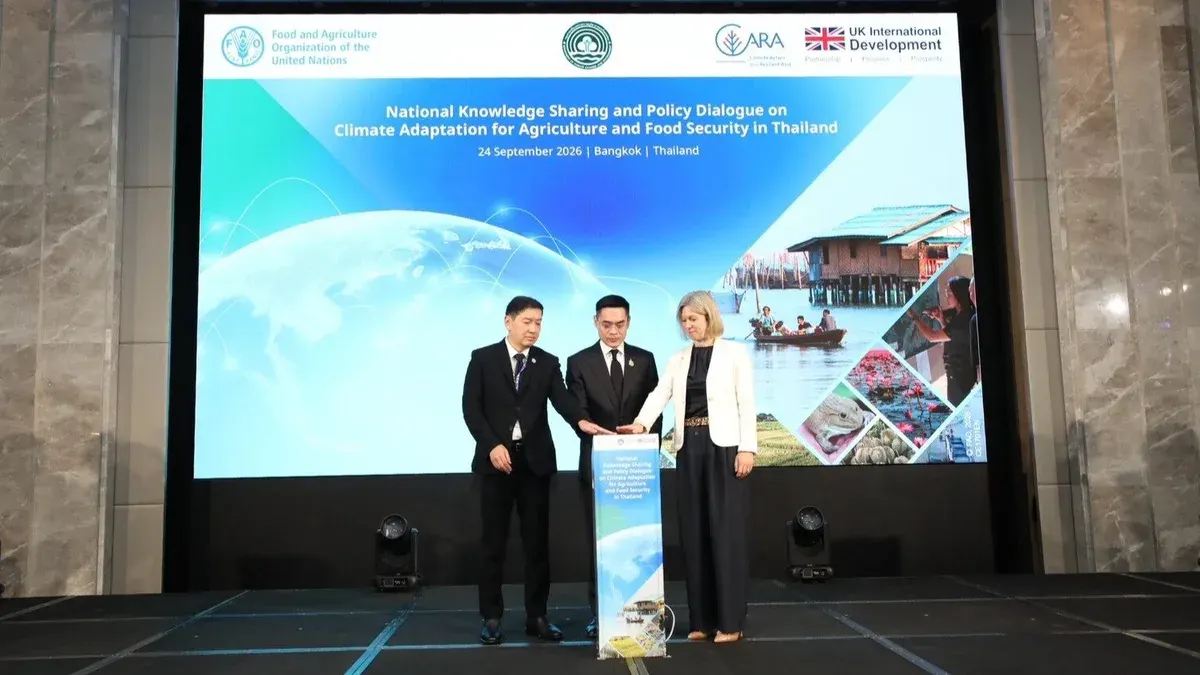
Thailand's Department of Climate Change and Environment has joined forces with the UK Foreign, Commonwealth and Development Office and the UN Food and Agriculture Organization to integrate climate adaptation strategies for local agriculture. The announcement was made on September 24 at the Amaree Watergate Hotel in Bangkok by Dr. Pirun Saiyasitpanich, director of the Department of Climate Change and Environment, alongside remarks from British Ambassador Nicola Pollitt on the partnership.
Dr. Pirun explained that climate change poses multifaceted risks affecting the economy, society, and environment. The World Meteorological Organization has reported that El Niño in the tropical Pacific is intensifying, with sea surface temperatures in the central tropical Pacific running 2.2 to 2.6°C above average from late July through mid-August 2026, with nearly a 100 percent likelihood of the phenomenon persisting until February 2027. This could alter temperature and rainfall patterns, increasing risks of heat waves, droughts, and heavy rainfall across multiple regions. Thailand must adapt global climate targets to the national context and implement them concretely through the National Adaptation Plan, which covers six priority sectors: water resources management, agriculture and food security, tourism, public health, natural resource management, and human settlements and security. Implementation will span national, sectoral, and local levels, with the 2026–2030 adaptation action plan serving as the key mechanism to drive practical measures and outcomes.
For Thailand, agriculture is vital to the economy, food security, and livelihoods, yet remains vulnerable to climate change. Previous droughts have damaged approximately 17 million acres of farmland, and floods have affected roughly 29 million acres. Future risk assessments show approximately 16 million acres of rice paddies at risk from flooding, underscoring the need for agricultural adaptation that goes beyond damage reduction to build resilience, strengthen adaptive capacity, and enhance food security through scientific data, technology, and local knowledge, combined with multi-sector collaboration and area-specific measures. Dr. Pirun noted that such an approach is essential.
British Ambassador Nicola Pollitt stated that under the Climate Action for a Resilient Asia programme, the UK is proud to support this collaboration with Thailand since 2024 to advance climate adaptation from planning into concrete implementation and tangible results.