Go-Kart Organizers Enforce Strict Rules After Cadet B Protest
Go‑kart organizers issued strict technical rules after a protest in the TrueVisions Championship 2026 Cadet B class, requiring identical karts and engines and allowing only limited part substitutions. Any engine failure must be addressed through a formal spare‑engine request to the R.Y.S.T. race officials. The rule sheet was shared by TNP Motorsport manager Pornanut Lerttaveewit, whose son competed, following the controversy over rival driver “Payu”’s victory.
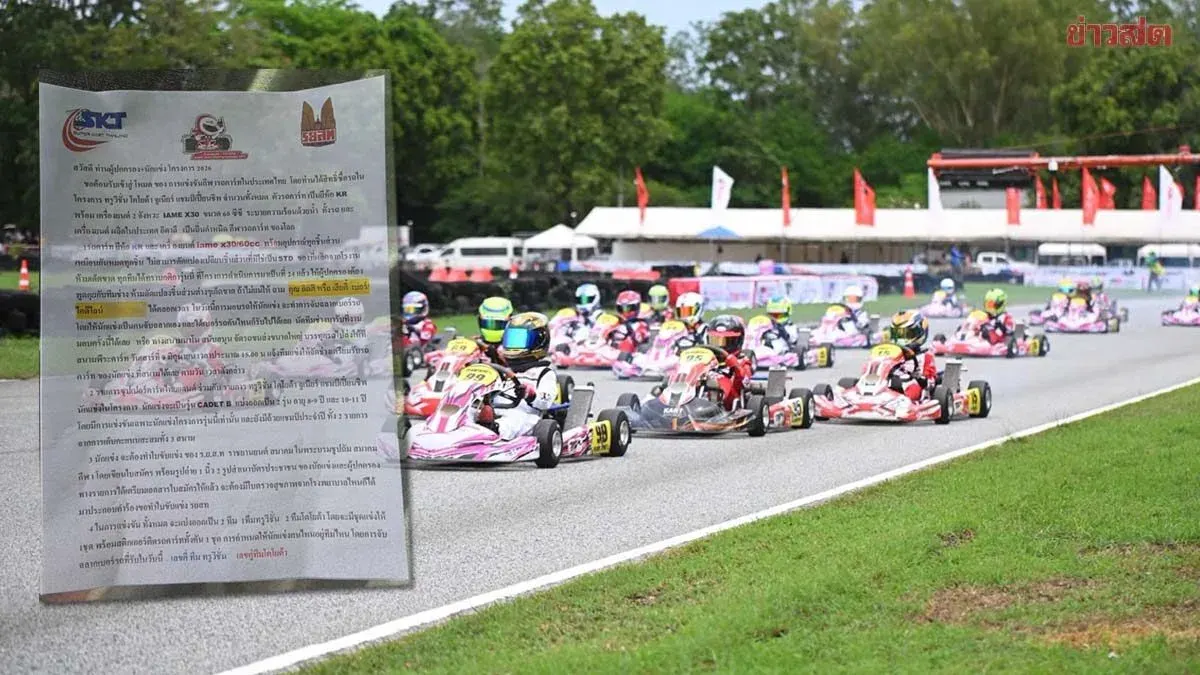
The organizers sent the go‑kart regulations to parents, forbidding any modification of parts except spark plugs, seats, throttle cables, fuel lines, rear sprockets and chains. They stress that every kart and engine must be identical; if an engine breaks down and cannot race, a written request for a spare engine must be made only to the race officials from the R.Y.S.T.
The notice follows a protest after the TrueVisions Championship 2026 Cadet B race, in which young “Payu” won first place. Pornanut Lerttaveewit, husband of Benz Prikthai and manager of TNP Motorsport—whose eight‑year‑old son “McLaren” competed—posted the rule sheet distributed to all participants. The first clause specifies that KR‑brand karts fitted with IAME X30/60cc engines, together with all supplied components, must be exactly the same, and no non‑standard parts may be altered or replaced.
The following page outlines kart preparation rules. After receiving the kart, it must be handed to the service team; there are eight items, seven of which concern the kart itself:
1. Install the seat provided with the kart (only one size). If it is too small, the team may source a new or used seat to fit the driver; any brand is acceptable, but an extra battery must be added to the kart kit as it does not come from the factory. 2. The steering column, steering arm and steering wheel may be adjusted to suit the driver’s size. 3. The rear sprocket and chain supplied with the kart may be changed to suit the track; any brand and tooth count are allowed, but the front sprocket must have 11 teeth and bear the IAME X30 logo that comes with the engine. 4. The throttle and brake levers may be trimmed to fit the driver’s legs, but the leg‑bracket assemblies must meet safety standards and not break easily. The brake‑lever safety cable attached to the kart must never be removed, as it serves as a backup if the brake lever fails. 5. Pre‑race inspection: if the engine is damaged and cannot be used, a written request for a spare engine must be submitted only to the race controllers from the R.Y.S.T.; the damaged engine must be presented for inspection to confirm it is unusable. If the engine merely runs poorly, a spare may not be used because all karts must remain identical.
Engine checks are preliminary; after the race a detailed inspection will be made. Failure to pass will result in loss of trophies and points. Thus the preliminary check only confirms the engine seal number for that event, not that the engine has passed inspection.
6. All karts and engines must be identical, using only factory‑produced parts. The kart chassis is a Ricaro unit and the engine must display the IAME X30 logo; the exhaust pipe diameter is fixed at 12.5 mm to limit horsepower. Any alteration or reduction will incur an immediate foul‑loss penalty.
*Items that may be changed (if not mentioned in the rules, factory parts must be used; when in doubt, ask the circuit official or race committee): 6.1 Spark plug – free choice 6.2 Seat – free choice 6.3 Throttle cable / fuel hose – free choice 7. Tyres for dry conditions may be MG brand, new or used, but must be registered via QR code with the scrutineers; wet‑weather tyres…