Thailand's PISA 2025 Scores Rise; Ministry Prepares Students for AI and Media Literacy
Thailand's PISA 2025 scores improved across science, mathematics, and reading, with the Education Ministry now preparing students for media and AI literacy assessments planned for 2029. The ministry will integrate critical thinking and ethi
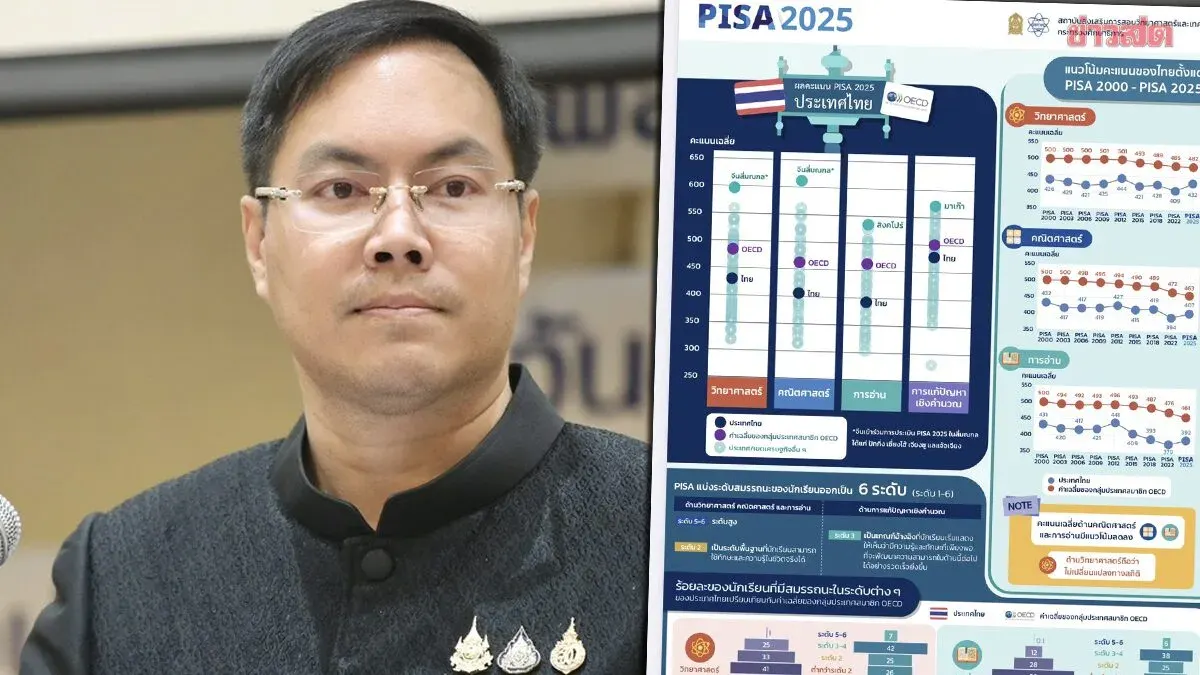
Deputy Education Minister Akkhraphan Kankittinan announced Thailand's improved PISA 2025 scores at a press conference on September 8, held at the Prince Palace Hotel in Bangkok. He thanked the Office of the National Education Commission, the Education Ministry, and educators nationwide for their role in boosting the results. Akkhraphan emphasized that PISA 2025 is not an endpoint but a starting point for developing Thai students' learning in the coming years.
The Education Ministry has laid out five core policy areas linked to raising PISA scores: returning time to teachers, narrowing budget-driven inequality, advancing real-world learning, making schools safe spaces, and drafting a new national education law to provide long-term structural reforms.
Looking ahead to 2029, the OECD will assess Media and AI Literacy for the first time, measuring students' ability to distinguish fact from fiction and use AI tools responsibly. Rather than waiting until 2029, the Education Ministry will begin preparing students immediately by integrating critical thinking, information discernment, and ethical AI use across all subjects from primary level onward. The ministry plans to develop practical teaching guidelines based on PISA insights, covering mathematics, science, reading, digital skills, and AI, and will work with teacher-training institutions to equip the next generation of educators.
Thailand's PISA 2025 results showed science scores of 432 points, mathematics 407 points, and reading 392 points—all improvements over 2022. Computational problem-solving scored 476 points, approaching the OECD average of 500.