Thailand's Virtual Ocean Revealed Through VR Technology
A new VR project digitizes Thailand's underwater ecosystems, allowing people to virtually explore coral reefs and marine life from the Gulf of Thailand and Andaman Sea without diving, while creating a permanent archive of endangered species
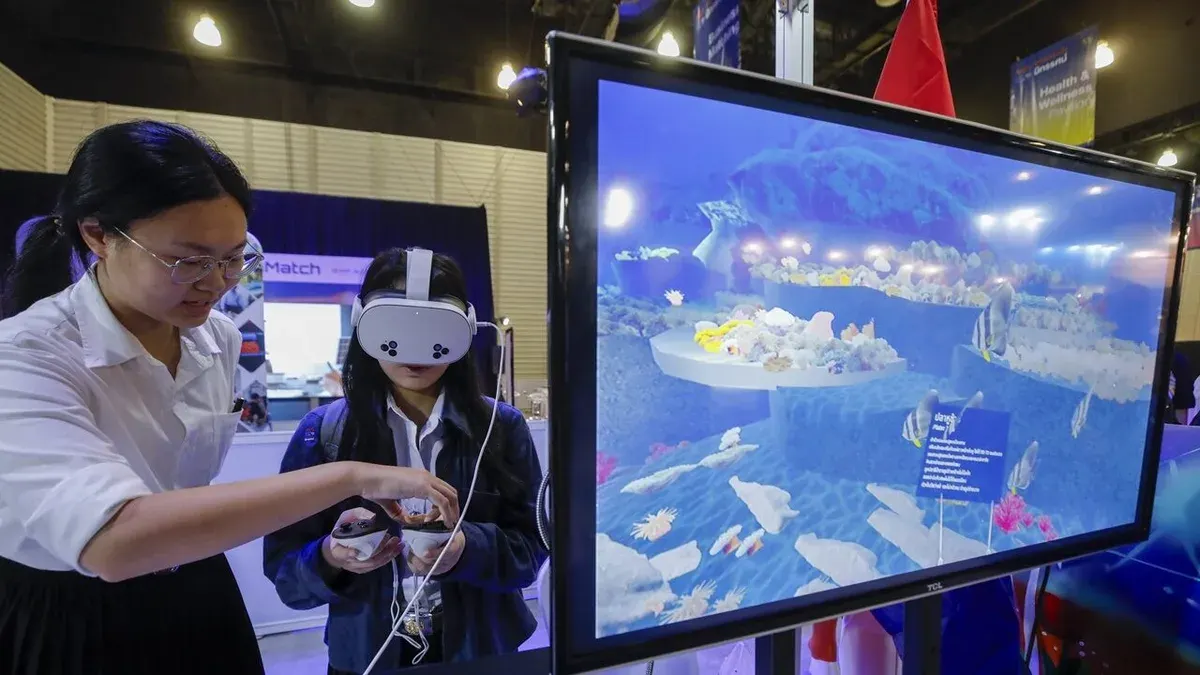
A new project called 'Thai Sea in Virtual Reality' is bringing Thailand's underwater ecosystems to life using immersive VR technology. The initiative, part of a royal plant conservation program, allows people to experience diving into Thai waters without getting wet—from viewing vibrant coral reefs to encountering colorful fish species in stunning detail.
Imagine standing amid brilliantly colored coral formations with cartoon fish swimming close enough to touch, every detail sharp as if you were actually there. You need no diving suit, no breath-holding, and never leave your location. This is what the 'Thai Sea in Virtual Reality' project aims to deliver across Thailand by using VR technology to preserve and transmit the diversity of fish, coral, and Thai marine resources from both the Gulf of Thailand and Andaman Sea as a permanent underwater archive.
Associate Professor Ananya Charoenphon, a specialist in coastal ecosystem management and fisheries resources and head of the project, explains that it began from limitations in traditional marine ecology education. Conventional underwater study requires costly and difficult diving surveys, while many species face extinction risk. With rapid growth in AI and digital technology, the team saw an opportunity to create a virtual underwater ecosystem to share knowledge without actual diving.
The work operates under the royal plant conservation program framework, aiming to collect data on natural resources and rare endemic marine species from both the Gulf of Thailand and Andaman Sea, then distribute this knowledge to school networks and communities across the country.
Creating the virtual underwater world requires close collaboration between science and technology. The process begins with gathering natural data, environmental conditions, habitats, and aquatic animal photographs into a database. This is then passed to artists, architects, and industrial designers who create three-dimensional models, which are then handed to robotics engineers and software developers for integration into an immersive VR system. The critical step is verification of accuracy, with Associate Professor Ananya strictly overseeing scientific details including body proportions, fin positions, tail shape, and scale relative to coral formations. The team must also balance model realism with the processing capabilities of computers and VR headsets, as higher detail requires greater computational power.
The key difference between VR and traditional learning media is the shift from 'viewing images' to 'immersive experiential learning.' Previously, marine ecosystem education relied on textbooks or two-dimensional photographs that could not clearly convey body form, swimming motion, or actual habitats. VR offers true three-dimensional immersion underwater, allowing viewers to see parrotfish, wrasses, and damselfish swimming around coral reefs in close-up detail beyond what real divers sometimes can access. The experience can also be displayed on large screens for group learning in classrooms, museums, and public spaces. The project currently focuses on two pioneering provinces.