Thailand to Give Farmers 1,000 Baht per Rai Subsidy
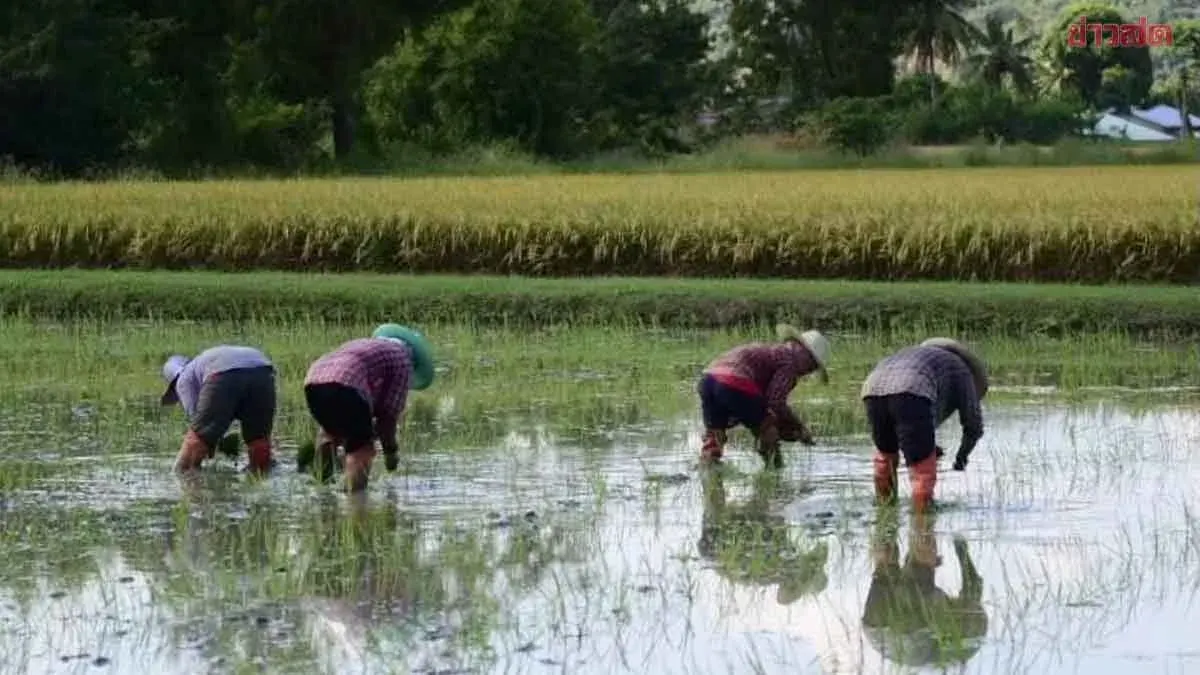
The Thai government plans to give rice farmers 1,000 baht per rai and cover half of any market price shortfall below the guaranteed level. The measures target about 4.7 million households and up to 39 million rai of paddy fields for the 2026/27 crop year. Officials also approved working groups to shift unsuitable rice land to other crops and to develop an internal market for organic and GAP rice.
Sarawut Nueangjong, Secretary to the Minister of Agriculture and Cooperatives, disclosed the outcome of the first 2026 meeting of the National Rice Policy and Management Committee’s sub‑committee on production. He said the meeting implements the National Rice Policy Committee’s orders to set direction for efficient rice management and to find a direct solution to farmers’ distress. Attendees included executives from the Ministry of Agriculture and Cooperatives, related agencies, and farmer representatives.
The meeting considered assistance measures for paddy farmers in the 2026/27 production year. Agencies agreed in principle on two approaches:
1. Support and Capacity Building Project for Rice Farmers 2026/27 – provides 1,000 baht per rai for management and quality development, limited to 10 rai per household (maximum 10,000 baht per household). The target is about 4.69 million registered households, covering roughly 39 million rai.
2. Rice Price Stability Promotion Project 2026/27 – compensates 50% of the price difference when the market price falls below the guaranteed price, with a limit of 10 rai per household. Compensation uses reference prices for five rice groups: Hom Mali rice, off‑area Hom Mali, white rice, Pathum Thani rice, and glutinous rice, based on the average of the past seven days’ benchmark price from the Department of Internal Trade and the Rice Millers Association.
The Department of Rice, Department of Agricultural Extension, Bank for Agriculture and Agricultural Cooperatives (BAAC), and Department of Internal Trade are tasked with drafting detailed proposals for both approaches for submission to the National Rice Policy Committee for further consideration.
Regarding progress on measures to maintain paddy price stability for the 2026/27 production year and long‑term improvements to the production structure, per the National Rice Policy Committee meeting on June 11, 2026, relevant agencies are working on the paddy loan deferment project for 2026/27 and the loan project for rice collection and value addition by farmer institutions for 2026/27, to be submitted to the Cabinet for approval of projects and budgets.
Additionally, the meeting approved the appointment of two working groups under the sub‑committee:
1. A working group to convert unsuitable rice fields into other economic crops and to drive other production‑related projects, plans, and measures. 2. A working group on the project to promote and develop an internal market system for agricultural products (the project linking organic rice and GAP rice markets comprehensively) to enhance policy‑level management effectiveness and achieve concrete results.
For the production forecast for paddy in the 2026/27 year, the planted area totals 60.835 million rai, with an expected yield of 25.831 million tonnes of paddy. The Irrigation Department reported water storage status as of October 8, 2026: total storage in large reservoirs nationwide is 58,744 million cubic metres (83% of capacity), confirming sufficient water for irrigated areas, with continuous monitoring of drought‑risk zones outside irrigation schemes.
The Ministry of Agriculture and Cooperatives places great importance on comprehensive management of the rice system, including preparing immediate relief measures for farmers.