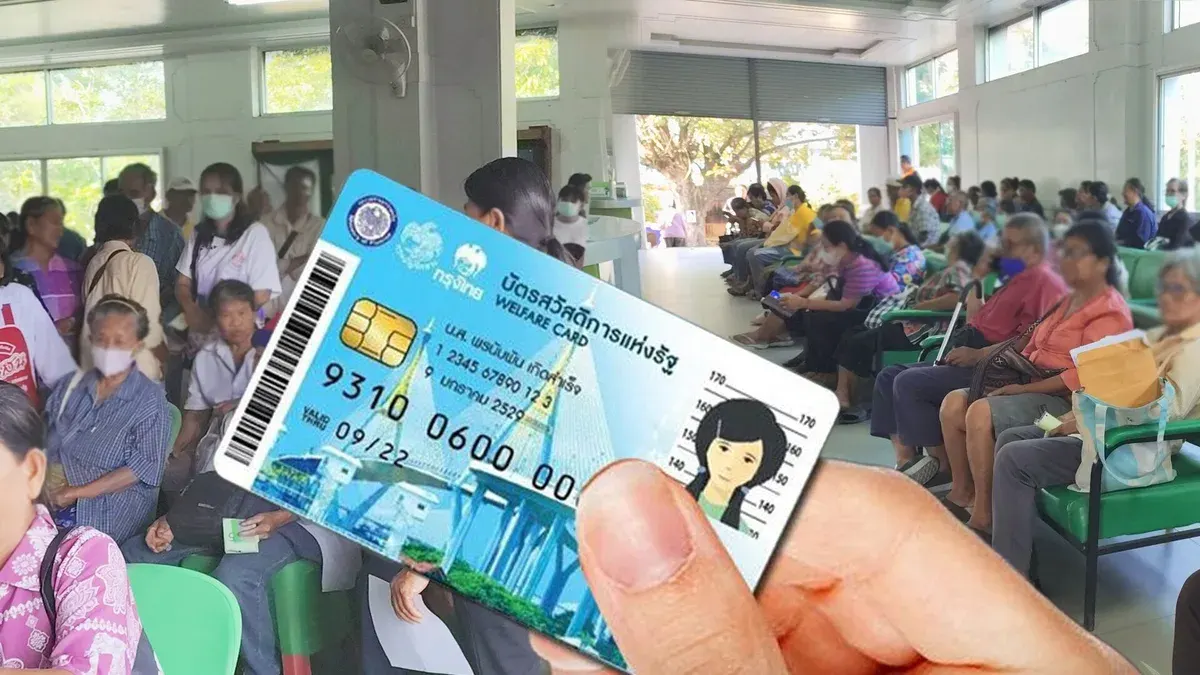
Thailand's welfare card system has wrongly denied benefits to thousands of genuinely poor citizens due to strict criteria and fragmented government databases that fail to communicate with each other.
Thailand's new means-tested welfare card registration has exposed major flaws in the country's social welfare system. While the government aims to remove fake beneficiaries and help an additional 2.3 million genuinely poor people, overly strict criteria combined with outdated verification systems have wrongly denied benefits to many struggling citizens.
In principle, the government's goal is sound—public funds should reach people in genuine hardship, not those exploiting loopholes. The problem is in the execution: rigid conditions and slow-moving checks have stripped benefits from thousands of truly poor Thais. Many have only just learned they appear as company directors, shareholders, car owners, or landowners without ever knowing it, because criminals used their personal data to commit fraud.
The burden of proof has fallen on ordinary people, not on those who stole their identities. The crisis deepens because Thailand lacks an integrated government database system. The Interior Ministry, Finance Ministry, Transport Ministry, and other agencies each keep and verify their own records. When data does not connect, screening errors are inevitable—and the truly poor suffer the consequences.
Another failure: the Finance Ministry had no appeals mechanism in place from the start, despite knowing that major rule changes would affect millions. It only later rushed to open a hotline to handle complaints.
The chaos reflects inadequate state planning. A good welfare system is not measured by strict rules alone, but by accuracy, fairness, and genuine ability to help the truly disadvantaged without creating unnecessary hardship. The complaints from poor Thais who lost their cards should not be dismissed as temporary problems. Instead, they are a warning that the state must urgently reform its databases, integrate data across all agencies, and close loopholes where criminals can abuse stolen identities.
Government must ensure that poor and low-income people do not become double victims—first of criminals who misuse their personal data, and then of administrative failures, even if those failures were not intentional.