Three Generations Keep Karen Weaving Alive in Chiang Mai
In Ban Lai Kaew, Chiang Mai, three generations of Karen women are preserving the ancient art of backstrap loom weaving. Twin sisters Sukkaew and Sukham, who began weaving at age 12, now earn primary family income from the craft, enabling their children to attend university. Their 12-year-old daughter Sunny represents the third generation learning the tradition, creating a sustainable cultural and economic legacy for their community.
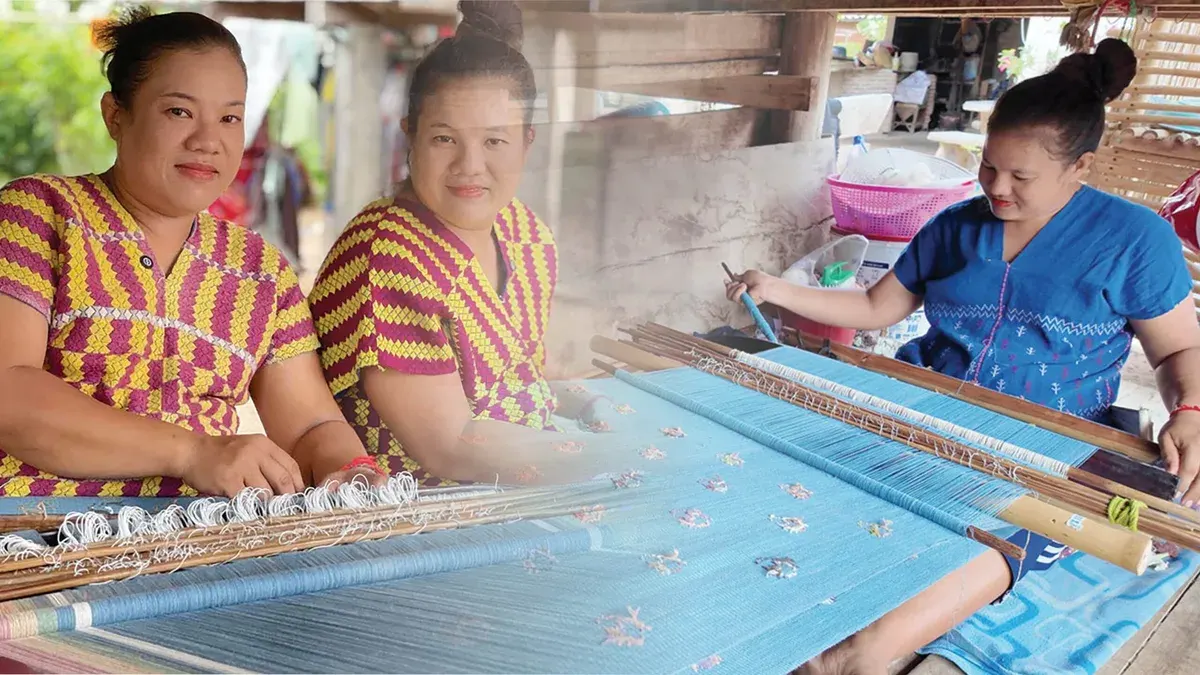
In the quiet of Ban Lai Kaew in Chiang Mai's Doi Tao district, the ancient wisdom of Karen women's backstrap loom weaving continues to be passed down vibrantly. From the world's oldest weaving technique, skills are now transmitted to a new generation, creating a group of three-generation weavers who grow and progress together.
Sukkaew and Sukham Pu Kam
Almost every Karen girl grows up beside her mother's loom, just like Sukkaew and Sukham Pu Kam, the twin master weavers who recall: "When we were kids, around grade 6, age 12, we were like other village children who went to practice weaving floor mats and shoulder bags at Uncle Tuay's Karen Weaving Learning Center. We've been weaving since age 12."
Mae Pi Pu Kam weaving near her child
From that starting point, their small hands gradually moved from small cloth pieces to larger ones, advancing to intricate pick-up patterns. "The first pattern we practiced was the turtle pattern. It was very hard. We had to write it down in notebooks and practice repeatedly. At first it wasn't pretty but gradually improved. Now we can do any pattern," Sukkaew and Sukham recount together.
Pee Nok Niramon interested in pick-up patterns, how to pick them up
Today, what was once supplementary income during free time from farming has become a stable primary livelihood supporting families. Many mothers have proudly sent children through university thanks to weaving income. "It helps the most. When it's not longan season we weave, save money to send kids to school, pay tuition, and school supplies," Sukkaew says.
Sukham and daughter Sunny, third-generation weaver
Encouragingly, the third generation is now emerging. Sunny Nattaneecha, Sukkaew's young daughter, practices weaving shoulder bags for herself during holidays and has begun earning income selling her own woven cloth, following precisely in her mother's footsteps.
Sukham's chicken pattern
Looking beneath the house, one sees a beautiful warm relationship: Grandmother Pi, a classic-generation weaver, concentrates on the 'Kai Kong' pattern, an ancient original design that fewer people can weave today. Beside her are the twin mothers Sukkaew and Sukham, two strong pillars weaving cloth pieces and pick-up patterns with exquisite skill. Meanwhile, 12-year-old Sunny sits cross-legged, absorbed in weaving her first shoulder bag.
Sukham, the younger twin
This isn't a handover of duty then departure, but sitting working side by side, walking forward together. Grandmother passes on spirit and roots; mothers drive it with skills that generate income; the child receives inspiration to carry forward into the future.
Sukkaew, the older twin
In another village corner, several new-generation working-age weavers have decided to return home, turning natural handwoven cotton into sustainable careers. This return brings not only steady income to the community but restores happiness, warmth, and time to care for mothers and grandmothers closely.
Pee Nok Niramon visits twin weavers
The intertwined way of life of this Karen family in Ban Lai Kaew resembles cotton thread that never breaks, beautifully and sustainably weaving past, present, and future together.
Come support the three-generation weavers of Doi Tao, Chiang Mai, in the Field of Sunlight, the Doi Tao Karen series, online via the "Thung Saeng Tawan" page and Payai TV — a series full of people's smiles, hope, and future.
Wassawan Rongdech