Songkhla University Launches Disaster Management Model
Songkhla University launched the "Hat Yai Model Plus" project with 30+ partner organizations to improve flood preparedness in Hat Yai District through an integrated early warning system, smart shelters, and community strengthening programs.
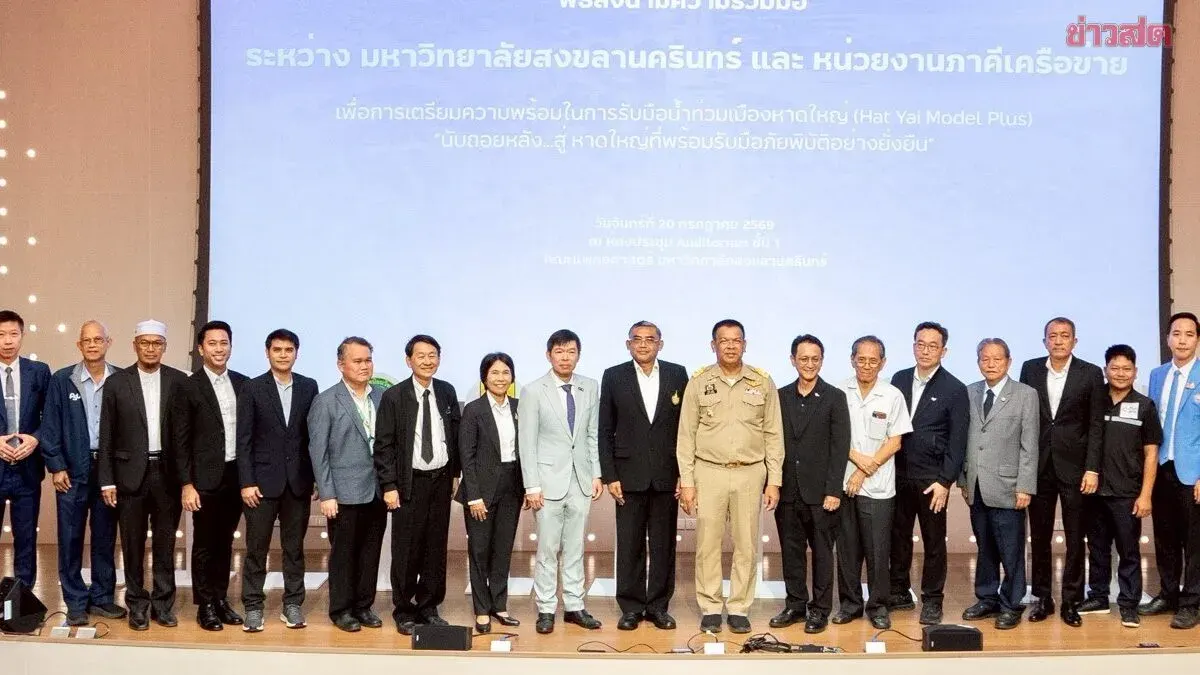
Prince of Songkhla University has signed research cooperation agreements with over 30 partner organizations under the "Hat Yai Model Plus" project to integrate knowledge, research, technology, and innovation to enhance flood preparedness in Hat Yai District, Songkhla Province, under the concept "Countdown to a Disaster-Ready Hat Yai."
The ceremony on July 20 was presided over by Jirawat Maneechodh, Deputy Governor of Songkhla Province, alongside university rector Asst. Prof. Dr. Niwat Kaeoprab, Prof. Dr. Komkrit Leksakul of the Office of the Committee for the Promotion of Science, Research and Innovation, and officials from government agencies, private sector, local government organizations, researchers, and media.
Hat Yai District serves as an economic, educational, medical, transport, and tourism hub for Southern Thailand, but faces recurring flooding from geography, urban expansion, and climate change impacts. Past floods have revealed gaps in warning systems, data coordination, interagency communication, and community preparedness.
The Hat Yai Model Plus uses science, research, and innovation to improve integrated disaster management through four main initiatives: (1) a real-time flood early warning system integrating rainfall forecasting, hydrological modeling, and artificial intelligence for the Klang U-Taphao watershed; (2) a public health information network center for emergency and disaster management; (3) development of smart shelters for flood response; and (4) community strengthening programs.
All projects receive support from the Office of the Committee for the Promotion of Science, Research and Innovation (PCSRI) and funding from the National Research Council of Thailand (NRCT).
The cooperation agreement represents a joint commitment by over 30 government, academic, local government, water resource, disaster prevention, public health, business, industry, and community organizations. Rather than a symbolic signing, it represents genuine integration through shared data, coordinated planning, system development, resource exchange, and cross-sector collaboration to build an efficient and sustainable flood management system.