Central Bank Launches Three New Tools to Unlock SME Credit
Thailand's central bank is launching three new credit mechanisms to help small and medium-sized enterprises access financing, with results expected from late 2026 onward, addressing a structural problem that has left most startups unable to
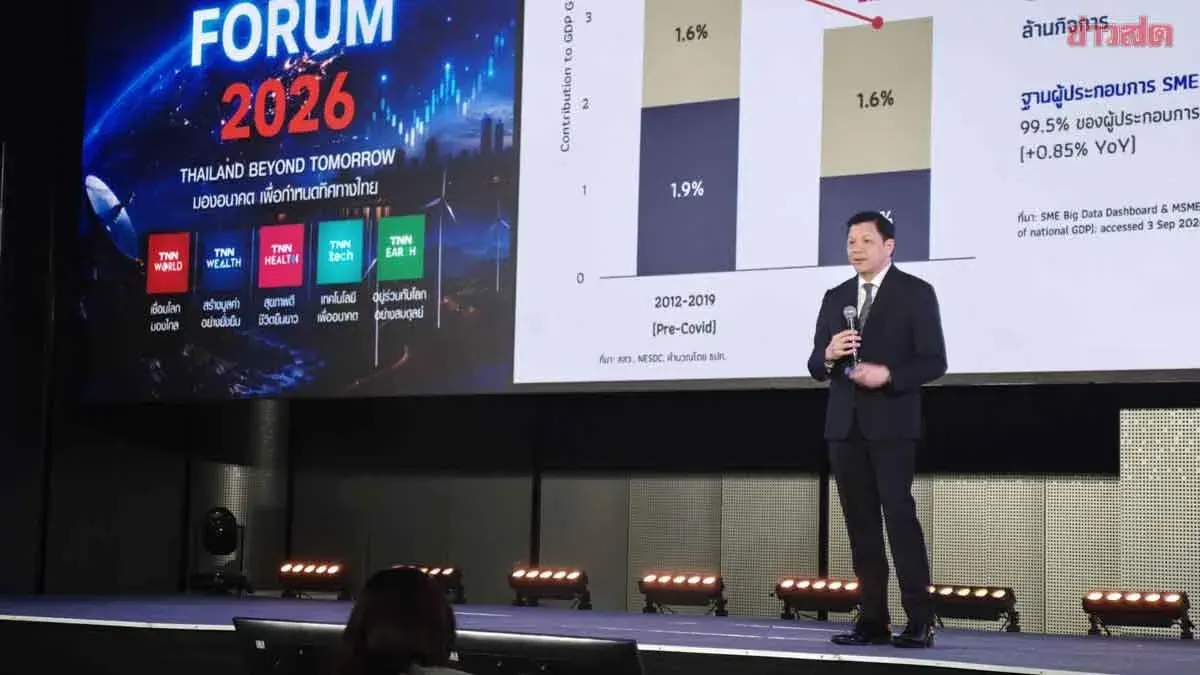
The Bank of Thailand is preparing to roll out three new mechanisms to overhaul the financial ecosystem and tackle the problem of small and medium-sized enterprises being unable to access credit. Results are expected to begin appearing in late 2026 and continue through 2027.
Bank of Thailand Governor Vithai Ratanakorn, speaking on the topic of SMEs as drivers of Thailand's future economy, noted that the SME problem is a structural challenge the Bank of Thailand prioritizes. SMEs employ 13.6 million people—70 percent of the country's workforce—and account for roughly 35 percent of GDP.
SME credit has contracted for 16 consecutive quarters, contrasting with large business lending, which has begun to expand again, reflecting a K-shaped economic recovery. Meanwhile, SMEs face low survival rates, declining profitability, high interest costs, and limited access to credit.
Bank of Thailand data shows that new SMEs without financial history face a credit rejection rate as high as 78 percent. SMEs operating for 0-5 years can actually access credit in only 11 percent of cases, while enterprises with a history of bad debt face a 86 percent rejection rate. The top 30 percent of high-potential SMEs access credit in only 21 percent of cases, compared to large businesses in the same bracket which access credit at 61 percent.
Meanwhile, SMEs bear an average interest cost of 6.9 percent, higher than large businesses at around 3.9 percent. Non-performing loans for SMEs have risen to approximately 9–9.5 percent compared to below 2 percent for large businesses. The proportion of enterprises with insufficient profit to pay interest, or zombie firms, has increased from 2 percent to nearly 6 percent.
Ratanakorn said the Bank of Thailand cannot help every SME, particularly those without potential or unable to adapt. Instead, it will focus support on SMEs that remain profitable and can expand, representing approximately 38 percent, as the primary target group, enabling them to access credit and continue growing.
The three new mechanisms are:
1. SME Credit Portal: A central matching platform connecting capable SMEs with commercial banks, state financial institutions, and non-bank lenders to resolve incomplete information problems. Developed in collaboration with the Thai Chamber of Commerce, SME Associations, and financial institutions, the launch is expected in December 2026.
2. New Credit Guarantee Mechanism: Running parallel with the Small and Medium Enterprise Credit Guarantee Corporation, using funds from the Financial Institutions Development Fund (FIDF) of approximately 20,000 million baht instead of government budget. The tested mechanism can generate 70,000 million baht in credit, with a target of 80,000 million baht before moving toward a long-term goal of 100,000 million baht per year. Combined with the Small and Medium Enterprise Credit Guarantee Corporation's guarantee of an additional 100,000 million baht, the total guarantee ceiling will reach 200,000 million baht per year—roughly half of the estimated 400,000 million baht annual SME credit need. The proposal will be presented to the Finance Minister within 3–4 months, with implementation expected in 2027.
3. Alternative Data Bureau: Led by the Finance Ministry, collecting alternative data such as utility bills, electricity payments, tax records, e-statements, payment gateway data, and mobile phone information to assess repayment capacity. This will make it easier for freelancers and SMEs without credit history to access credit, while also serving as a screening tool to filter out gray-market businesses and irregular transactions from the financial system. Expected to be operational in 2027.
Ratanakorn said all three mechanisms will be important tools in adjusting the country's financial ecosystem, aiming to direct capital to capable SMEs that can grow, which will strengthen SMEs' role in driving Thailand's economy.