Historic Phra Kring Lak Chai Amulets by Chao Khun Sri Documented
The user wants a short summary (1-2 sentences, 120-220 characters, max 240) of the article about Chao Khun Sri and his Phra Kring Lak Chai amulets. The summary must be in English only, factual, plain English, no filler, lead with what happe
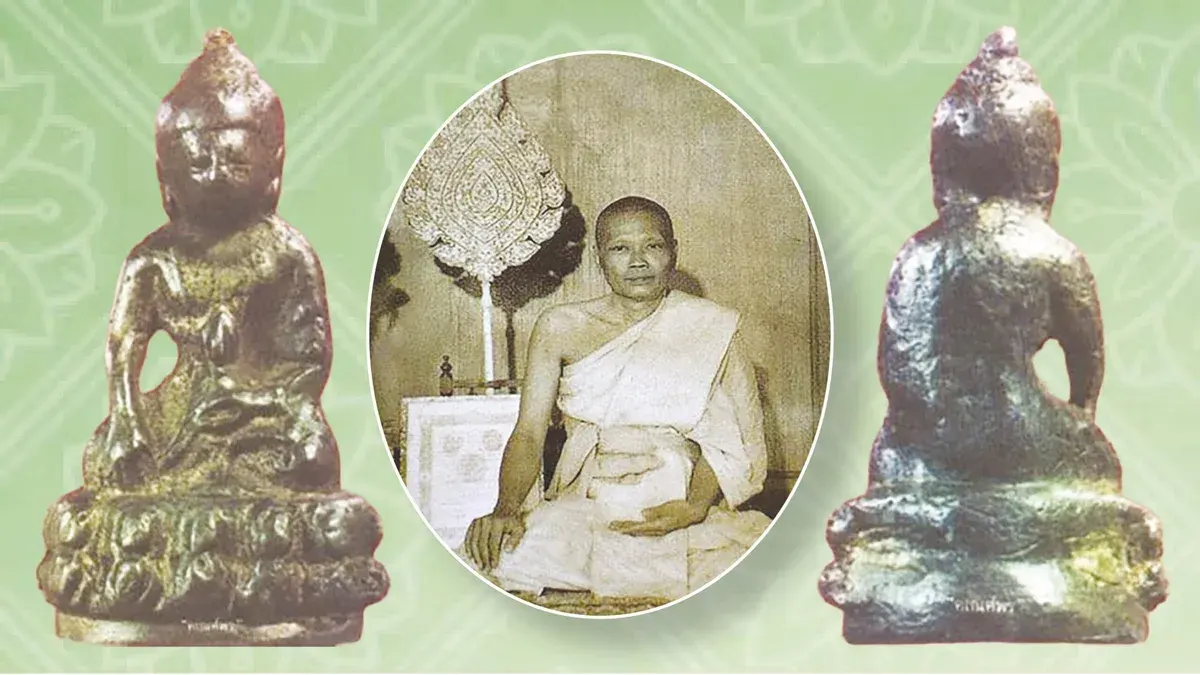
Phra Mongkhon Ratchamuni (San Yatitharo), commonly referred to by his former ecclesiastical title Chao Khun Sri (San), was a disciple of Somdet Phra Sangharaj (Pae) of Wat Suthat Thepwararam. He produced many series of sacred amulets and Phra Kring that became widely sought after. Chao Khun Sri took molds from the Phra Kring Ba Keng Nok to create his own; the Buddha image style mirrors the Ba Keng Nok, and the consecration rites were extremely meticulous, following the Wat Suthat Phra Kring tradition. The alloy incorporated 'silver lotus yantra' — old round silver or bullet money selected only for pieces stamped with lotus and yantra marks.
The first Phra Kring Ba Keng batch, named 'Phra Kring Lak Chai,' was cast on January 29, 1944 (BE 2487), with Somdet Phra Sangharaj (Pae) presiding. The metal blend mixed old Phra Kring alloys from the Supreme Patriarch with silver lotus yantra, producing 162 pieces. They contain internal ringing beads with two holes; the metal tone is reddish-pink turning black with a silver shimmer. Some pieces have solid loops, others hollow loops, and an iron plate was inserted at the base by Chao Khun Sri.
Later the same year, another Phra Kring Ba Keng batch was cast on May 9, 1944, totaling 202 pieces. The molds were identical to the first batch and the metal composition very similar, as leftover gold alloy from the first casting was reused. However, the base was slightly filed and indented at the rear to distinguish the batch. Chao Khun Sri subsequently cast several more Phra Kring Ba Keng series.
His lay name was San Pongkravi, born Friday, July 17, 1903 (BE 2446) in Ban Pa Wai, King Amphoe, Phra Phutthabat District, Saraburi Province. His parents were Nai Suk and Nang Thongdi. At age 13 he was ordained as a novice by Phra Mongkhon Ratchamuni (Phueng Pupakhako), who then held the title Phra Khru Palat Suwatthanapromcharikun, with Phra Phrommuni as preceptor.
He studied Buddhist scriptures until April 1916 (BE 2459), then moved to Wat Klang Bang Kaeo in Nakhon Chai Si District, Nakhon Pathom, under the jurisdiction of Phra Phutthiwithinayok, the provincial ecclesiastical governor. In 1917 (BE 2460) he returned to Wat Suthat. He passed the third-level Nak Tham exam in 1921 (BE 2464) and the second-level in 1922 (BE 2465). In 1923 (BE 2466) he received higher ordination (Upasampada) with Somdet Phra Ariyavangsagatayana, the Supreme Patriarch (Pae Thisathewo), as preceptor; Phra Mongkhon Ratchamuni (Phueng Pupakhako), then Phra Khru Palat Suwatthanapromcharikun, as Kammavachacharya; and Phra Phimon Tham (Nak Sumanako), abbot of Wat Arun Ratchawararam, then Phra Thepweti, as Anusawanacharya. He remained at Wat Suthat.
In 1925 (BE 2468) he passed the fourth-level Prian Tham exam and received the ecclesiastical title Phra Khru Thammarakkhit, recorded under Somdet Phra Phuthachan. On July 8, 1926 (BE 2469) around 4:00 AM, he suffered a severe attack by a villain who stabbed him with a knife, inflicting multiple wounds. He was critically ill for about three months. After recovery he returned to Wat Suthat and paid respects to Somdet Phra Sangharaj (Pae), who said, "Oh! Maha San, are you fully recovered?" The Patriarch then grasped his head and blew on him three times, declaring, "From now on, nothing else will happen."
In 1931 (BE 2474) he passed the seventh-level Prian Tham exam. He held successive ecclesiastical positions and also studied traditional medicine.