Honda City V: Budget Trim Delivers Real Fuel Savings
Honda's new City V hybrid delivers impressive fuel economy of 23.6 km/liter while offering core safety features and solid performance, though the base model skips premium amenities like ambient lighting and a rear-view camera to keep costs
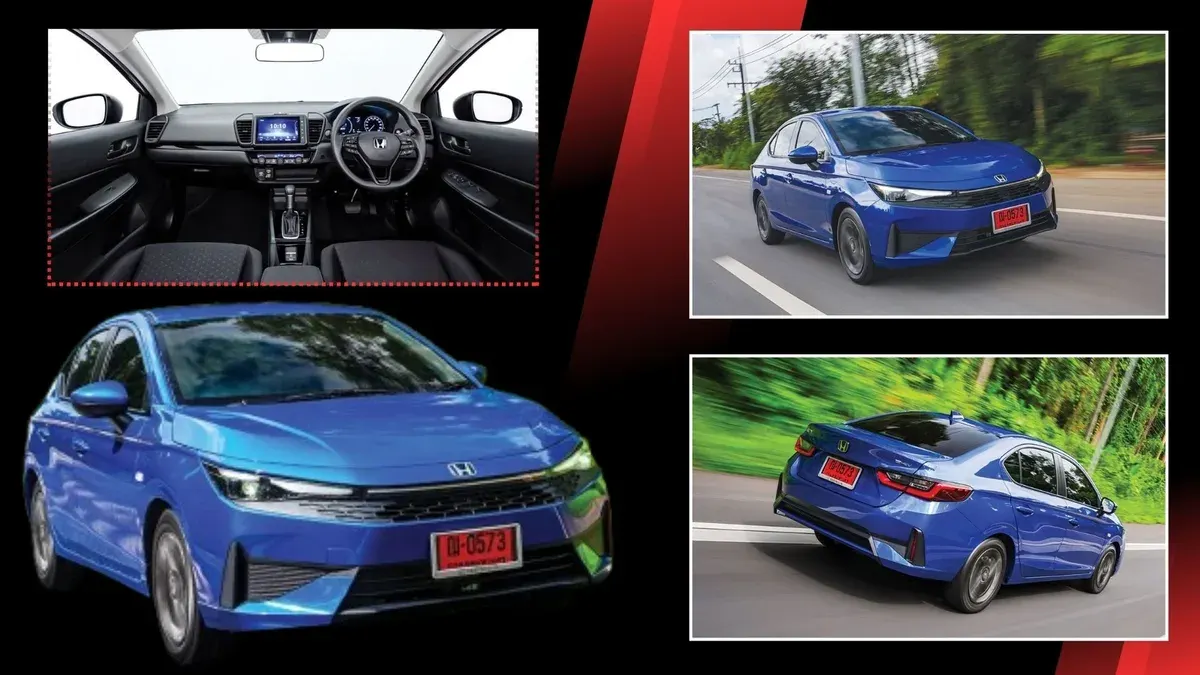
Honda conducted a test drive program offering both the 1.0 turbo and full hybrid versions of the new City. Due to shared driving time with other journalists, the Honda Automobil PR team offered the V model—the base hybrid variant—for evaluation. The City V targets buyers seeking solid driving performance and safety without premium comfort features or high pricing.
Exterior styling mirrors other trims with a new grille, LED headlights, and 2D H-Mark logo. The V omits the connecting light bar that spans between left and right headlights and uses a different alloy wheel color. Inside, all models share a 7-inch TFT display and electric parking brake with auto hold. The V differs with cloth seating in black, no ambient cabin lighting, no rear air vents, and an 8-inch non-touchscreen display. Notably absent is a rear-view camera—a limitation some find unsafe, though the test driver preferred relying on side mirrors to avoid nighttime glare, suggesting a budget reversing alarm as a solution.
All trims include Honda Sensing safety technology: collision warning with brake assist, lane departure warning and control, vehicle-ahead movement detection, remote engine start with air conditioning, and automatic door lock when the key fob moves away.
Pickup occurred in Bangkok's Bang Chan area. Urban traffic posed no problem for the City's compact size and responsive hybrid powertrain. Dual electric motors paired with E-CVT transmission and a 1.5-liter engine deliver combined torque of 253 Newton-meters. The front-vehicle movement alert system proved especially useful at traffic lights, notifying drivers within 3–4 seconds when traffic ahead begins moving.
After 2–3 days of city driving through heavy traffic and occasional rain, the test driver reported impressive fuel economy: 119.9 kilometers traveled at 23.6 km/liter consumption.
The following day, the route shifted to Nakhon Ratchasima province. Acceleration to the legal 120 km/h limit felt swift and smooth—the suspension felt stable enough to suggest a slower speed. Cabin quietness stood out, with wind noise minimal even above 110 km/h; only the 1.5-liter engine sound registers, charging the battery for storage.