Koh Lanta makes up to 100 tonnes of rubbish a day, and its dump is four rai
Around 45,000 to 50,000 tonnes of waste have accumulated on a four-rai site, the island adds 40 to 50 tonnes a day and up to 100 in high season, and about half of it is food. Six local councils, a May 2026 declaration and a programme running since 2021 are why Koh Lanta is being written up as Thailand's model rather than its warning.
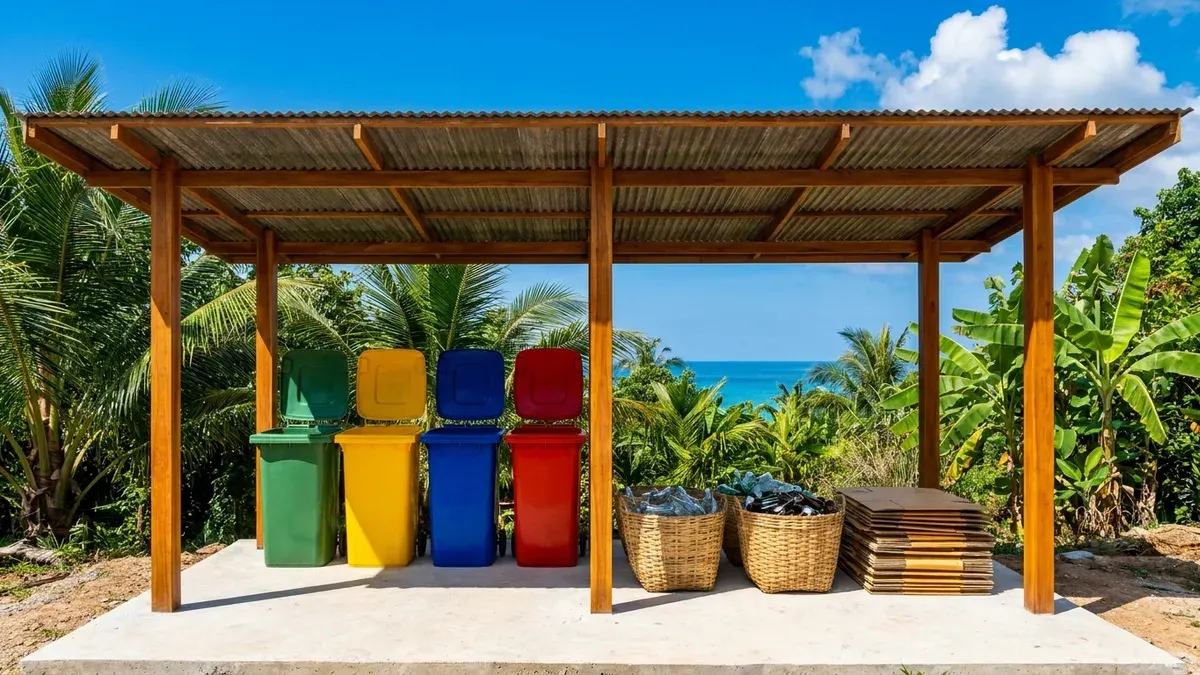
Photo: Illustration generated for Lanta News
Koh Lanta's dump is four rai. That is about 6,400 square metres, roughly the footprint of a football pitch. Sitting on it, according to figures presented by the agencies at a signing on the island in May, is somewhere between 45,000 and 50,000 tonnes of accumulated rubbish.
The island adds 40 to 50 tonnes a day. In high season that rises to as much as 100.
Where it comes from, and what it mostly is
Roughly half of it is food. Not plastic, not packaging: food scraps and organic matter, with plastic the next largest share. That ratio surprises people who assume an island waste problem is a bottle problem.
It matters because the two need completely different answers. Plastic has to be kept out of the sea. Food waste is heavy, it is wet, it rots, and it is the part that can stop being waste at all if it is separated at the point where it is dropped.
The island's waste is also not generated by a stable population. It comes from residents, from the large unregistered population who live and work here without being counted, from businesses, and from the tourists who arrive in the hundreds of thousands. The same island, in the same four rai, absorbs all of it.
Six councils, one problem
Koh Lanta district is not one local authority. Six separate local government bodies cover it, and until recently each dealt with its own rubbish. One island, one dump, six sets of rules.
What has changed is that they stopped working separately. The six have been co-ordinating on food waste specifically, working directly with restaurants, accommodation businesses, fresh markets and households rather than trying to fix the problem at the dump, which is the end of the pipe and the most expensive place to fix anything.
The Lanta Bay Declaration
On 5 May 2026, at the Koh Lanta district office, that work was signed into something larger. The Lanta Bay Declaration commits its signatories to cutting plastic waste before it reaches the sea.
The Department of Marine and Coastal Resources presided, with its director-general Pinsak Suraswadi. Krabi's governor Angkoon Silatewakul signed. So did ThaiHealth, the Andaman Foundation, the Sustainable Development Foundation, WWF Thailand, the Thai Sea Watch Association, the Rak Lanta Network and the Koh Lanta Tourism Business Association, alongside local councils, community groups and tourism businesses.
What they committed to is unusually concrete for a declaration. Cut foam and single-use plastic. Put in waste separation. Hotels, resorts, restaurants and convenience stores to sort and recycle. Schools to go foam-free and put students into the work. Government bodies to buy green. Festivals and tourism events to run under environmental rules rather than good intentions.
Announced alongside it: community-managed marine zones covering 17 villages, nine in lower Lanta Bay and eight in the upper bay.
Why the sea is the point
Thailand leaks an estimated 22,800 tonnes of plastic into the sea each year, part of more than 12 million tonnes worldwide. The reason the declaration targets the source rather than the shoreline is that once plastic is in the water it does not stay plastic in any recoverable sense. It breaks into pieces too small to collect.
Research cited at the signing found microplastic in more than 80 per cent of a sampled group of Thai people. That is the argument for sorting a bin on an island: it is the only point in the chain where the material is still in one piece and still belongs to somebody.
Koh Lanta is being held up as the example, not the warning
This is the part that gets missed. Thailand has a famous rubbish island, and it is not this one. Koh Larn, off Pattaya, generates around 50 tonnes a day with no landfill of its own, and tens of thousands of tonnes have piled up at a dump in its centre.
Koh Lanta has the same shape of problem and has been going the other way. A community waste programme run with the Thailand Environment Institute since 2021 set up sorting stations, moved food waste into animal feed, brought the island's junk dealers into the recycling chain as participants rather than an afterthought, and ran beach clean-ups ahead of each season. It has since been written up nationally as a model for the rest of Thailand's tourist islands.
What a visitor can actually do
Separate your food waste if the place you are staying gives you a way to. It is half the stream by weight and the easiest half to divert.
Refuse the foam box and the extra bag. Both are specifically named in what the island's own businesses have agreed to stop handing out.
Take hard rubbish back off the island if you can. Everything that stays has to fit in those four rai.
What we could not verify
The tonnages above are the figures presented by the agencies and reported at the May signing. We have not independently measured them, and we could not find a published current capacity or remaining life for the landfill site itself. If you need the authoritative position on the site, that sits with the district and the six local authorities rather than with us.