Koh Lanta's electricity crosses the water on a cable made in Norway
The island is on the national grid, and the last stretch of that grid is a 33 kV submarine cable ordered in 2008, built at a plant in Halden and laid across the channel. It carries fibre as well as power. Here is what is on the public record, and what is not.
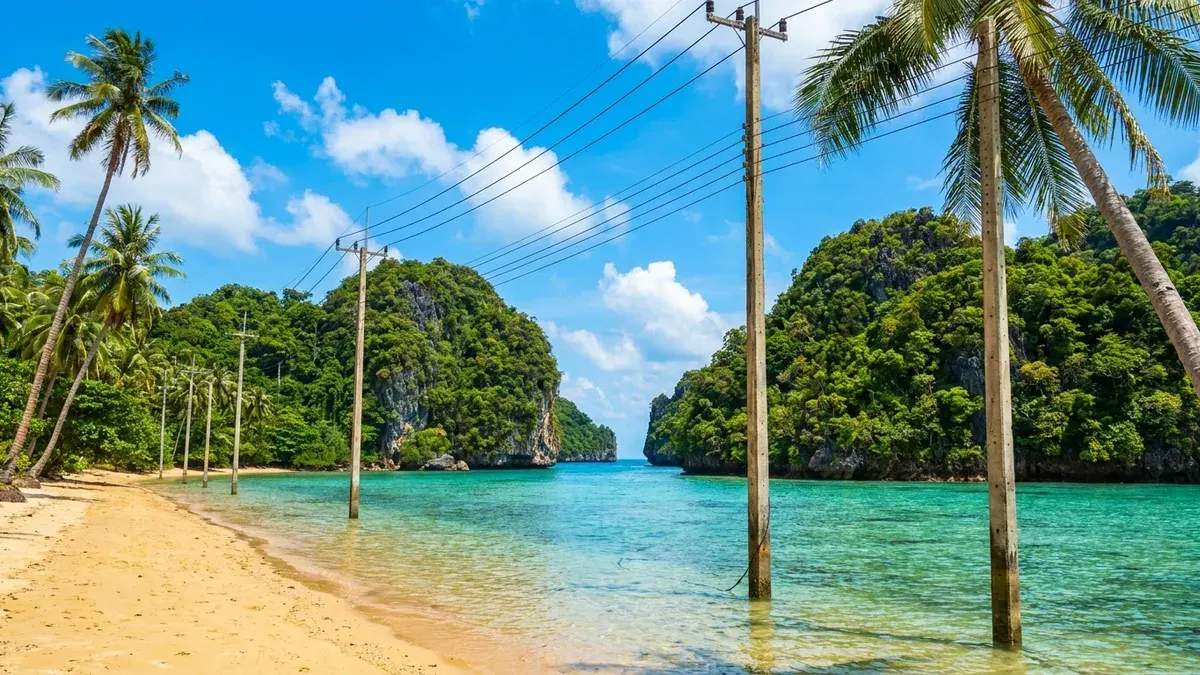
Photo: Illustration generated by Lanta News
Switch on a light in Saladan and the electricity behind it has come a long way, and the last part of the journey was underwater.
Koh Lanta is on Thailand's national grid, distributed here by the Provincial Electricity Authority, the PEA. Getting grid power onto an island means a cable across the seabed, and the one serving this corner of Krabi has a paper trail.
The contract, and what was actually laid
On 10 February 2008, the cable maker Nexans announced it had been awarded an 8 million euro contract by Italian-Thai Development Public Company Limited, better known as ITD, to supply 33 kV submarine cables for a set of new power links between islands in Krabi province. The work was on behalf of the PEA.
The named destinations were Koh Siboya, Koh Pu, Koh Phi Phi Don, Railay Bay and Koh Lanta. The order came to more than 33.3 km of cable in two lengths, and the specification is worth reading slowly:
- XLPE insulated, lead sheathed, copper conductor, three-core, 33 kV
- with an integrated fibre optic element
That last line is the detail most people miss. The same cable that carries the current also carries glass. Power and data cross the channel together, in one armoured bundle on the seabed.
The lengths break down like this. A single 3.8 km run does the Railay Bay crossing. About 27 km makes three links between Koh Pu, Koh Phi Phi Don and Koh Siboya. And then there is the line that concerns us: the 2.5 km Koh Lanta island interconnection.
Where it was built
Not in Thailand. The cables were manufactured at Nexans' plant in Halden, Norway, about as far from the Andaman as a cable factory can reasonably be, and delivered in October 2008. ITD's Marine department laid them.
Nexans' managing director for high voltage at the time, Patrick Barth, put the win down to the company's record with the PEA, noting they had just finished a 24 km, 115 kV link between the mainland and Koh Samui. That comparison is useful for scale: Samui, with its hotel towers and its airport, needed 115 kV over 24 km. This stretch of Krabi needed 33 kV over much shorter hops.
Why 2.5 km is the number to remember
Two and a half kilometres is roughly the width of water an island interconnection here has to cross, and it is the reason a storm, an anchor or a dredger is an electricity story rather than a shipping one. A submarine cable is a single line. There is no second route around it, and a fault is not a repair anyone makes in an afternoon: it means finding the break, lifting the cable off the seabed and jointing it at sea.
This is the quiet trade every Thai island makes. Grid power is cheaper, cleaner and steadier than diesel generators, and it arrives on one thin line that a passing hull can sever.
What we could not verify
We would rather print the gaps than write around them.
- Exactly which water that 2.5 km crosses. The contract calls it an "island interconnection", which reads like a link between Lanta Noi and Lanta Yai rather than a run from the mainland. We could not find a published route map, so we are not going to draw one for you.
- What the bridges changed. Koh Lanta's two bridges came later than this cable. Whether power now also crosses on a bridge, and whether the 2008 cable still carries the load or has become a spare, is not something we found on the public record.
- Capacity today. A 2008 design was sized for a 2008 island. We found no published figure for current demand or for any upgrade since, and the island has not stood still.
- The PEA's own route and capacity documents. Not obtainable from here. If you work at the Krabi PEA office and can correct any of the above, we would like to hear from you.
Everything above that is stated as fact comes from Nexans' own announcement of the contract, dated 10 February 2008. Where we have gone beyond it, we have said so.