Where Koh Lanta's water comes from, and why only three streams never dry
Almost no tap on Koh Lanta is fed by a public mains. The island has only three streams that run all year, which is why the state's plan for it pairs a surface-water plant with a desalination unit, and why villages built their own check dams decades before that plan existed.
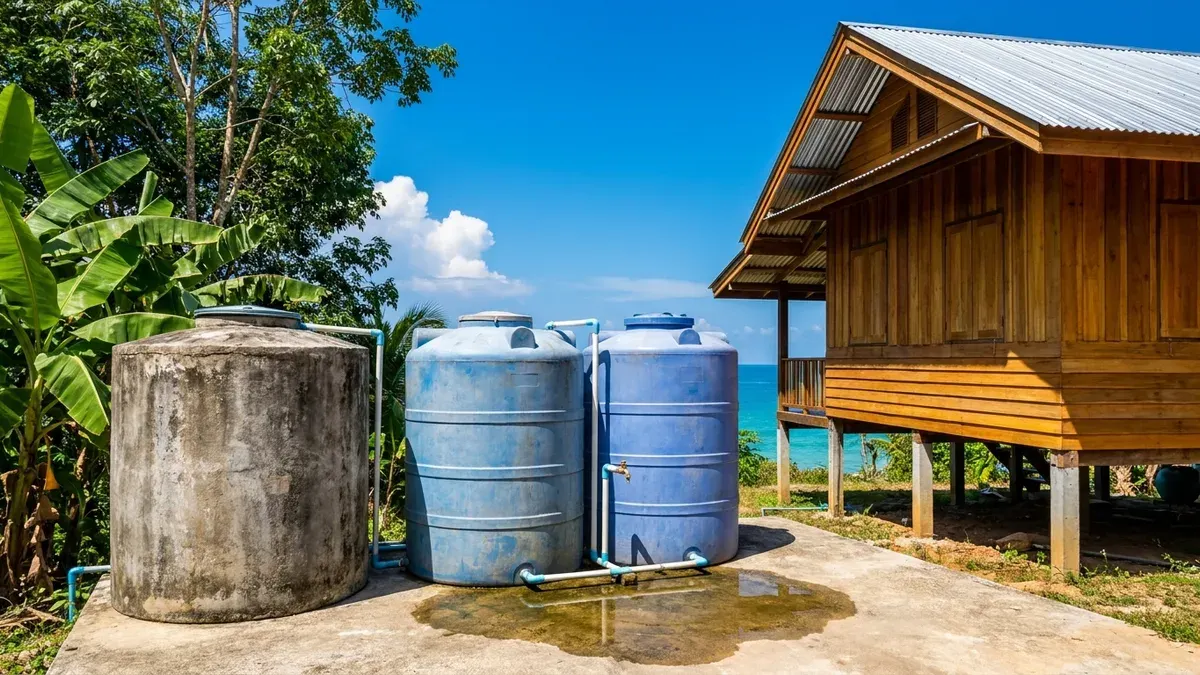
Photo: Illustration generated for Lanta News
Turn on a tap on Koh Lanta and the water in it has almost certainly not come from a public mains. It has come from a well under the property, from a tank on a concrete pad beside the building, or from a tanker that drove it there. Which of the three depends entirely on where you are standing.
That is not neglect. It is geology.
Three streams that never dry
Koh Lanta Yai has plenty of watercourses. Walk inland in October and you will cross several. Come back in March and most of them are stone and dead leaves.
Thai-language accounts of the island's water supply count only three that run all year: Khlong Chak, Khlong Nam Jued and Khlong Nin. Everything else is seasonal. For an island that doubles its population in high season, three streams is not a water supply, it is a starting point.
The state's own engineering agrees. When the Provincial Waterworks Authority finally drew up a plan for the island, it put its intake on a weir at Khlong Chak, one of the three.
The plan, and the number nobody mentions
On 11 May 2011 the Provincial Waterworks Authority announced what Koh Lanta had been waiting decades for: a real public water system.
It was not one plant but two, and the pairing tells you everything about the island's problem. A surface-water plant would take raw water from the Khlong Chak weir. Alongside it, a reverse osmosis plant at Ao Nui, a small crescent bay between Ban Khlong Hin and Ban Khlong Chak, would make drinking water out of the sea. Combined output: 2,400 cubic metres a day.
The supporting works were substantial. A low-lift pump station. A clear-water tank holding 3,000 cubic metres and an elevated tank holding 250. Roughly 47 kilometres of distribution mains. The site at Khlong Chak, Moo 5, runs to about 15 rai. The budget allocated for the 2012 financial year was 239.329 million baht.
An island that builds a desalination plant is an island that has run out of other answers.
What we could not establish
Here is the part we are not going to smooth over. We could not determine from public records what state that system is in today, fifteen years after it was announced. The authority's published notice covers the plan and the budget. We found no public completion notice, no opening, and no current service-area statement for the island.
That is a gap in what is published, and it should not be read as a claim that nothing was built. We are saying plainly that we do not know, rather than guessing in a confident sentence. Anyone who needs the current position should ask the Provincial Waterworks Authority's Khlong Thom branch, which covers Koh Lanta, and we intend to do exactly that.
Before any of it, the villages did it themselves
The most striking record of Koh Lanta's water problem was written in 2006, five years before the waterworks plan, by the Community Organizations Development Institute. It documented three villages that had stopped waiting.
At Ban Sangka-u, 117 households and around 400 people, residents drilled a well and then built check dams at nine points along the headwaters of their stream, working downward from the highest. They were made of plastic sacks packed with sand, stone, soil and cement. Eight of the nine were finished when the account was written. The dams were not there to hold a reservoir. They were there to slow the water down, catch sediment and store it in stages, so the stream gave up its water over months instead of weeks.
At Ban Hua Laem, 202 households and 740 people, about sixty households near the municipal boundary had managed to tap into piped water. The rest relied on Khlong Cha San, where the hospital kept a reservoir seven metres by four and the local administration had built a weir in 2001.
Ban Koh Por had it worst. Around ten wells, the largest beside the mosque, all of which went dry in the hot season. Residents queued overnight to fill containers, or took boats across to buy water at the market. The plan was three boreholes, a storage tank at the school, a main pipe to link them and solar panels to pump the water uphill. Nobody knew whether there was groundwater under the village at all, because nobody had ever drilled. One resident's summary of the risk, quoted at the time, was that you do not know until you try.
The work was supported after the tsunami through a livelihood project funded by the United Nations Development Programme, with community architects advising and villagers deciding. These figures are from 2006 and will have moved since; we quote them because they are specific and sourced, not because they describe today.
Why the mainland is no comfort
Krabi province does not have water to spare. During the 2024 dry season the provincial authority rationed supply by zone, four days on and three days off, across the provincial town and Ao Nang. On Phi Phi the boreholes began to fail and tap water stopped. Households without a well of their own were buying water by the cubic metre.
A bigger fix exists on paper: piping water from the Ratchaprapha Dam in Surat Thani across to Phuket, Phang Nga and Krabi. It is a project measured in years, not seasons.
What this means if you live here or are visiting
Do not drink from the tap, and do not assume the water in it is treated. It may be groundwater that has never been tested.
Expect every house, shop and resort to have storage tanks, because supply here is something you buffer rather than something you rely on. The tanks are not decoration.
Expect tankers in the dry months, roughly February to May. A property running its pool and its showers off a well in April is a property that may be buying water by the load.
And if the answer matters to you, ask the specific building rather than the island. On Koh Lanta, water is still answered property by property.