The three months the Andaman closes, and why Koh Lanta's longtails keep going out
The Andaman Sea closes to commercial fishing from April to June each year across 4,696 square kilometres, protecting spawning fish including mackerel that supply local markets; Koh Lanta lies within the closure zone, though longtail boats a
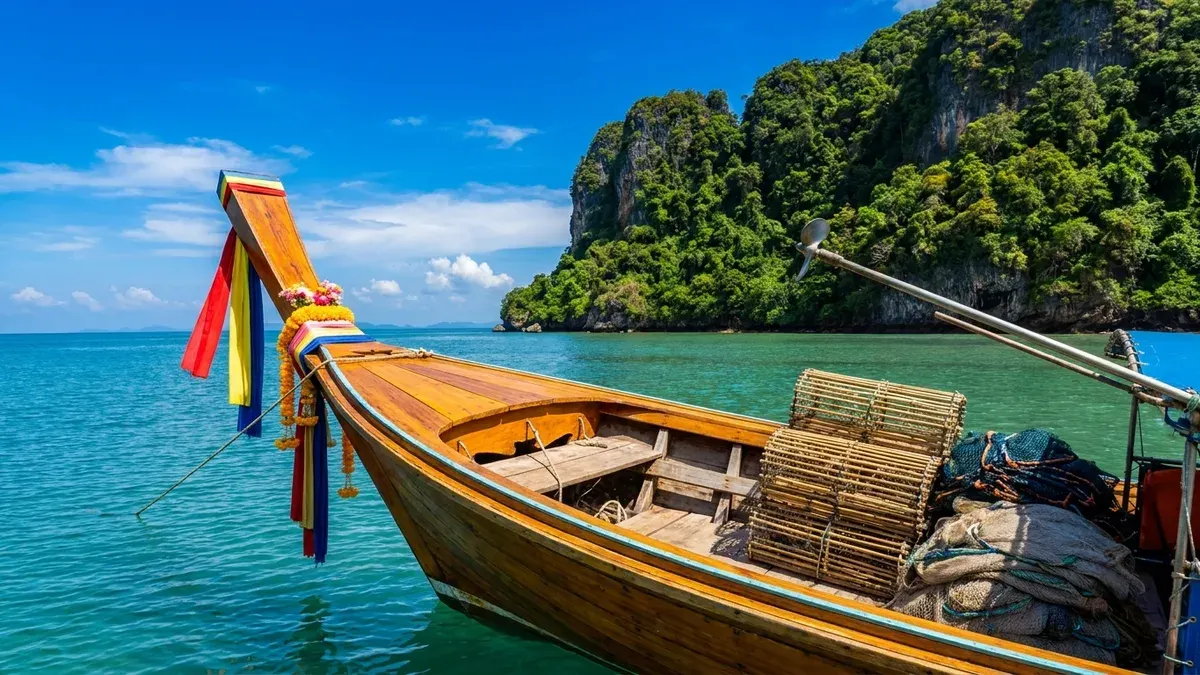
Photo: Illustration generated by Lanta News
Every year, on 1 April, a large piece of the Andaman Sea closes. It stays closed until 30 June. The measure covers 4,696 square kilometres of water off four provinces, Phuket, Phang Nga, Krabi and Trang, and Koh Lanta sits inside that stretch of coast.
Almost nothing on the island announces it. There is no sign at the pier. But it is the single biggest thing that happens to the sea around Koh Lanta each year, and it explains something visitors notice without being able to name: that in April and May the water off the island looks emptier than it did in February.
What the closure actually is
In Thai it is called pid ao, closing the bay. The formal name is longer: the measure managing aquatic resources during the season when fish carry eggs, spawn and raise their young. It rests on a Department of Fisheries notification dated 22 March 2018, which defines the closed area as running from the tip of Laem Phan Wa, in Mueang district of Phuket, down to the tip of Laem Yong Star, in Palian district of Trang.
Koh Lanta lies between those two points. Krabi is one of the four provinces named.
The department re-announces the measure each year rather than leaving it to run quietly. In 2025 the announcement ceremony was held on 27 March at the pier of the Krabi marine fisheries protection and suppression centre, in Sai Thai subdistrict of Mueang Krabi, presided over by the department's director-general, Bancha Sukkaew. Enforcement began on 1 April and ran to 30 June.
Why those three months and not others
The dates are not a round number chosen for tidiness. They track spawning.
The department published the reasoning from a 2024 study that combined data from its own survey vessels with data from commercial fishing gear. Across April, May and June, the economically important species in these waters were found to be overwhelmingly in breeding condition: short mackerel, known here as pla thu, along with Indian mackerel and sardine, showed sexual maturity in more than 80 per cent of individuals during the window.
The same work measured how thick the water is with fish larvae. In March, before the closure opens, the average was 577 individuals per 1,000 cubic metres of water. In May, inside the closure, it was 258 per 1,000 cubic metres. Those are young fish in open water, the year's recruitment, sitting in exactly the area the nets would otherwise be working.
Pla thu is worth pausing on, because it is not an abstraction to anyone who eats here. It is the small, deep-bodied mackerel that arrives at a Thai market steamed and curled into a round bamboo basket, and it is on menus all over Koh Lanta. The closure exists in large part to keep that fish arriving.
Who has to stop, and who does not
This is the part that gets lost in the shorthand. The sea does not close to everyone.
The measure is aimed at the gear that takes fish at industrial volume. Thai reporting on the closure describes trawl nets and purse seine nets as the prohibited types. Fishers may work only with the gear the notification permits; anything else is an offence under section 70 of the Royal Ordinance on Fisheries.
English-language coverage of the closure has consistently reported an exemption for small village boats: under 10 gross tonnage, with engines under 280 horsepower. That is the size of an ordinary wooden longtail. On that reading, the boat that goes out from a Lanta village before dawn to lift crab traps is not what the closure is aimed at, and keeps working through April and May while the big steel boats stay tied up.
This matches what the island looks like in those months. Fewer large vessels on the horizon, the same small boats close in.
Does it work
The department publishes a number that is hard to argue with, and it is the most interesting figure in the whole measure.
Average catch rates inside the closed area were 135.5 kilograms per hour before the measure, 166.2 kilograms per hour during it, and 471.9 kilograms per hour after it lifted. Roughly three and a half times as much fish per hour of fishing after three months of leaving the water alone.
That is the argument for the closure in one line: the boats catch far more in July because they did not fish in May.
Enforcement is real rather than notional. Patrol boats work the area for the three months, and the penalty reported for fishing the closure with prohibited gear is a fine of 50,000 baht or five times the value of the catch, whichever is greater.
What this means if you are here in April, May or June
Not very much, directly, and that is worth saying plainly rather than inventing drama. Restaurants do not run out of fish. The small boats still land, the country's other coast is not closed, and frozen and farmed supply fills the rest.
What changes is the texture of the water. It is the quietest the Andaman gets for working boats, in the same months the southwest monsoon starts to build and the island slides into low season. If you are out on a longtail in May and the sea feels unusually empty of other traffic, that is not the weather. It is the law.
What we could not verify
Three things, and we would rather print them as gaps than smooth them over.
- Exactly where the line runs relative to Koh Lanta's own bays. Every published description of the closed area we found gives it as a total, 4,696 square kilometres, bounded by two capes hundreds of kilometres apart. None draws the boundary island by island. Koh Lanta is inside the span and inside a named province; which specific waters off which beach fall inside the polygon is a question for the Krabi fisheries office, not for a map we could find.
- The 2026 notification. The measure has run 1 April to 30 June in each year we could check, and it is re-announced annually. We could not confirm from published sources that the 2026 dates were identical, and we are not going to assume it.
- The full permitted-gear list. Thai coverage names trawl and purse seine as prohibited; the vessel exemption at 10 gross tonnage and 280 horsepower comes from English-language reporting rather than from the notification text itself, which we were unable to retrieve in full.
If you fish these waters and know how the line runs off Lanta, we would like to hear from you.