Thailand Develops AI Technology to Screen Stroke Risk
Thailand's public health sector is developing AI technology to screen stroke risk using advanced pulse and blood vessel sensors, aiming to identify at-risk patients early and reduce the country's high stroke mortality rates. The Department
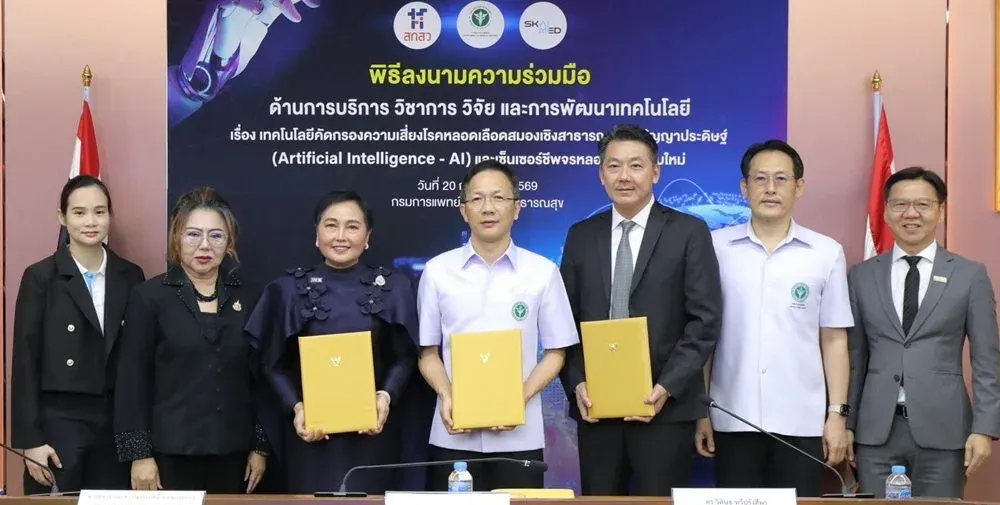
The Department of Medical Sciences under the Ministry of Public Health has signed a memorandum of cooperation with the Office of the National Science, Research and Innovation Committee (NSRIC) and SKAI MED Co. Ltd. to drive a research and development project on artificial intelligence-based public stroke risk screening technology using new pulse and blood vessel analysis sensors. This collaboration integrates medical knowledge, research, and technological innovation, focusing on creating high-precision, easy-to-use screening tools with broad public accessibility that will serve as a key mechanism to reduce stroke incidence and complications in Thailand while supporting the real-world application of technology in the public health system for improved health outcomes.
Dr. Nattapong Vongwiwat, director-general of the Department of Medical Sciences, stated that this collaboration represents a significant step in applying artificial intelligence technology to the public health system to proactively address stroke, a leading cause of death and disability in Thailand. The focus is on pre-stroke screening to identify at-risk individuals before disease onset, using AI to enhance early-stage risk screening efficiency and enable faster, more accurate treatment access, ultimately reducing health, quality-of-life, and long-term economic losses.
The project's core objective is to build a reliable clinical database, with the Department of Medical Sciences taking the lead in clinical operations and coordinating Doppler Ultrasound assessments—the gold standard for blood vessel evaluation—while working with neurology specialists to create a Clinical Reference Dataset for training AI algorithms to achieve high accuracy tailored to the Thai population's physiological characteristics.
Beyond technical development, the Department of Medical Sciences emphasizes oversight and safety standards by closely coordinating with the Thai FDA to regulate AI software-based medical device standards and registration, ensuring this technology is applied safely and effectively within Thailand's public health system and sets new standards for future healthcare.
Professor Dr. Sompoung Khlaiyhaang, director of the Office of the National Science, Research and Innovation Committee (NSRC), discussed strategic support roles, noting that NSRC is ready to serve as a key mechanism for advancing the country's science, research, and innovation policies by focusing on connecting research networks, funding sources, and relevant agencies into a unified system. NSRC's key role in this collaboration includes...