Thailand's Industry Minister Pitches Sufficiency Philosophy and AI² Strategy
Thailand's Industry Minister proposes balancing high-tech growth with support for small businesses and farmers through "Sufficient Economy" principles and a dual AI² strategy focused on advanced industry and agricultural development.
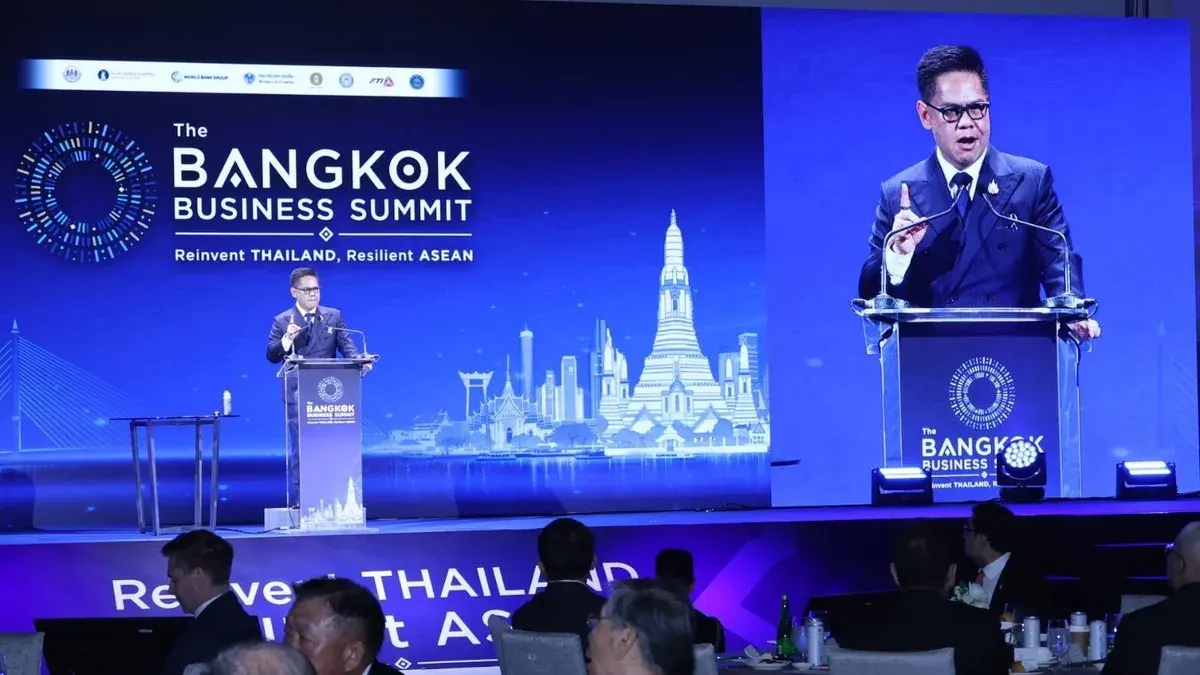
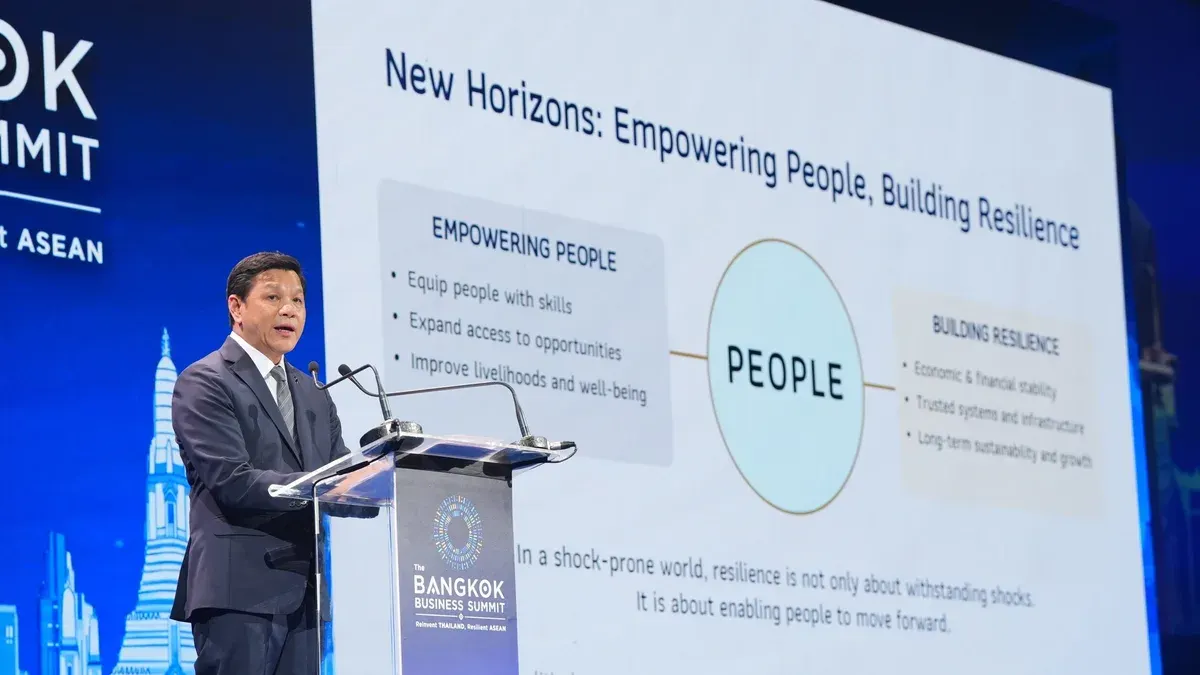
On September 3, Industry Minister Weerawuth Silpachcha delivered a keynote address at The Bangkok Business Summit: Reinvent Thailand, Resilient ASEAN, describing how the world faces structural volatility across geopolitics, technology, climate, demographics, and supply-chain fragility. This has pushed both global and Thai economies into a K-shaped pattern, with the upper branch representing modern, technology-driven industry—mostly funded by multinational corporations—and rapid digital growth, while the lower branch encompasses small and medium enterprises, local supply chains, farmers, and large numbers of workers who remain vulnerable and falling behind. Allowing these two branches to diverge further risks systemic collapse rather than sustainable growth.
"Growth that leaves more than half of Thais behind is not true progress—it is systemic risk," Weerawuth said.
The Industry Ministry has adopted Sufficient Economy Philosophy as its compass for restructuring Thai industry, applying principles of moderation, reasonableness, and resilience to business operations. This shifts the focus from reckless growth toward balanced, competitive, and shock-resistant expansion. A key tool is Thai Industrial Standard 9999, which embeds Sufficient Economy principles into organizational management, emphasizing long-term survival, stable value creation, good governance, and flexibility—aligned with international ESG (environmental, social, and governance) standards that are now essential for global market competition. The ministry is promoting this standard among small and medium enterprises to boost their capacity and integrate them into global supply chains.
Weerawuth outlined a strategic framework called AI²—two new economic engines: Advanced Industry and Agriculture Industry. Advanced Industry covers AI, automation, robotics, data infrastructure, advanced semiconductors, and digital technology, requiring foreign investment and global partnerships to upgrade Thai capabilities. However, the true measure of industrial development is not simply how much capital flows in, but how much Thailand's own capacity is elevated. New investment must bring knowledge transfer, technology development, skilled Thai engineers, connections linking Thai parts makers to global production networks, and Thai companies able to develop their own technology, intellectual property, and markets.
The second engine, Agriculture Industry, serves as a bridge to uplift the grassroots economy and lower-branch populations by transforming traditional farming into high-value agri-food and agri-tech sectors through biotechnology, future foods, pharmaceuticals, precision agriculture, advanced food processing, and production.