UOB Keeps Thai Stocks Neutral, Backs Foreign Equities on AI Wave
UOB raised its Thai GDP forecast to 1.9 percent but keeps Thai stocks neutral, instead recommending investors diversify into US, China, Taiwan, and South Korea to capitalize on the artificial intelligence investment cycle.
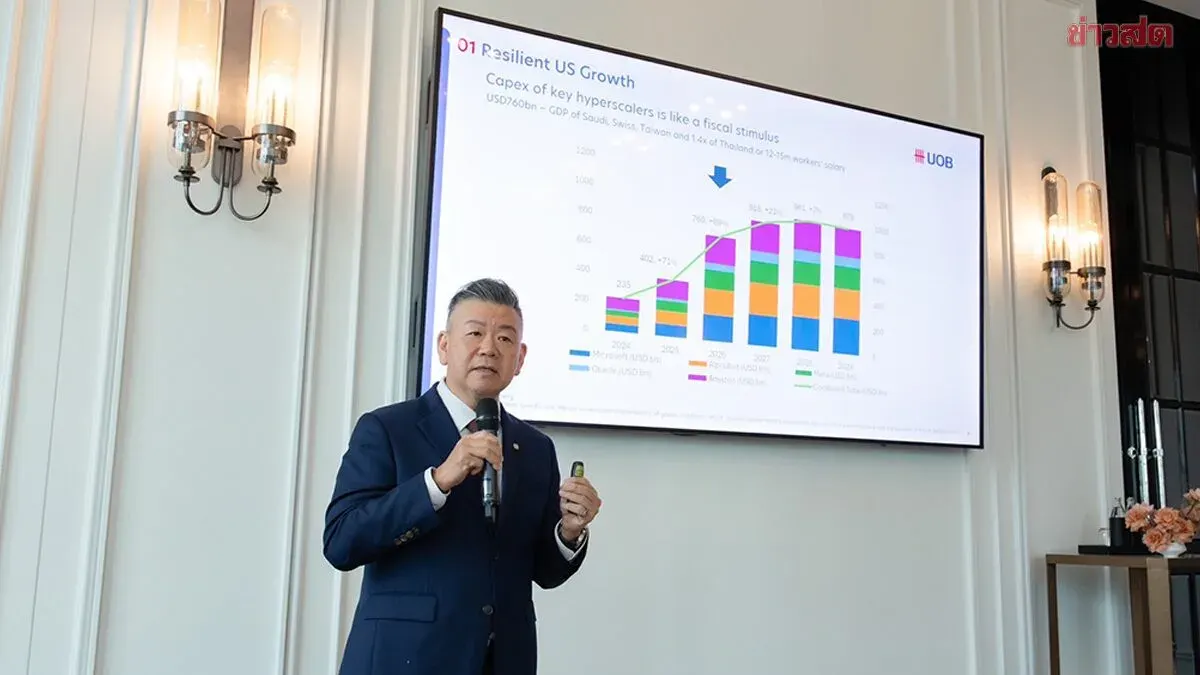
UOB has raised its 2024 Thai GDP growth forecast to 1.9 percent but maintains a neutral rating on Thai equities due to limited economic growth and concentrated market recovery. The bank recommends diversifying into the United States, China, Taiwan, and South Korea to capture the AI investment cycle, alongside three long-term investment themes.
UOB assesses global economic growth in the second half of 2024 as remaining solid, driven primarily by US consumption and technology and artificial intelligence investment. Despite mounting complexity—including elevated inflation, uneven sectoral growth, and geopolitical tensions—UOB forecasts US economic expansion of 1.7 percent, supported by high-income and high-asset households representing 20 percent of all households yet accounting for 60 percent of total consumption. Chinese economic growth is projected at approximately 4.6 percent, driven by industrial production and exports. US inflation is expected at 3.5 percent, suggesting the Federal Reserve will likely hold interest rates through the remainder of 2024 and may begin rate cuts in 2025.
Abel Lim, head of deposits and wealth management at UOB Thailand, said that despite global uncertainty, investors should not withdraw from risk assets. The key is selecting risk appropriate to expected returns, emphasizing quality companies with clear profits and cash flows, diversifying investments, and using market downturns as opportunities to accumulate long-term assets.
AI is reshaping investment opportunities, expanding from chip makers to energy infrastructure. UOB sees US growth sustained by labor market strength, high-income household spending, equity market wealth effects, and AI investment, with the economy exhibiting a "K-shaped" recovery where wealthy groups maintain high spending while others face income and purchasing-power pressures.
AI investment remains a key driver, extending beyond chip manufacturers and AI model developers to data centers, cloud computing systems, cybersecurity, memory chips, cooling systems, power generation, and electrical grids. UOB views Agentic AI—capable of planning, integrating data, and executing tasks autonomously—as a critical development that will boost efficiency and create new economic demands, broadening AI cycle investment opportunities from technology companies to infrastructure businesses.
Three Investment Themes for Structural Change
UOB identifies three key themes with investment potential in the second half of 2024 and beyond:
1. Agentic AI expands opportunity from software to infrastructure. AI is evolving from data creation and summarization to task automation. Agentic AI can plan, retrieve data, connect with software, validate information, and execute processes automatically. This expansion extends investment opportunities from technology companies and semiconductor manufacturers to data centers, cloud systems, cybersecurity, memory chips, cooling systems, power, and electrical grids, as increased processing requires electricity, cooling systems, and efficient data infrastructure.
2. From "Just in Time" to "Just in Case". Risks from COVID-19, geopolitical conflicts, trade tensions, and supply chain disruptions are prompting supply chain restructuring.