Abhisit Attacks Election Commission's Credibility Crisis
Former PM Abhisit Vejjajiva criticized the Election Commission's credibility during parliament's budget debate on September 10, citing public surveys showing eroded confidence and questioning why the agency hesitates to prosecute serious el
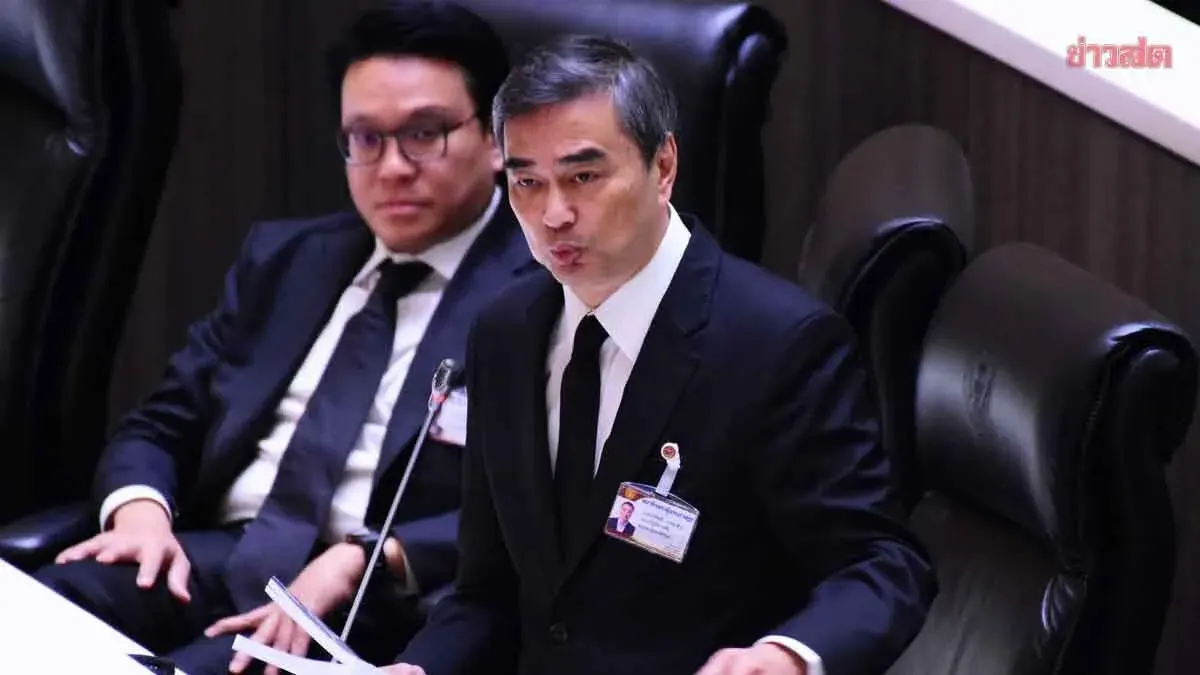
During the September 10 parliamentary session deliberating the 3.78 trillion baht fiscal year 2570 budget, Abhisit Vejjajiva spoke at 4 p.m. on Article 32 concerning independent agencies and prosecutors' offices with a budget of 7.85 billion baht. He proposed cutting the budget by 10 percent without targeting specific programs, arguing that while independent organizations are vital pillars of democracy, oversight of them remains limited. He noted that investigating the National Anti-Corruption Commission (NACC) requires reliance on parliament's president to refer matters to the Supreme Court for independent inquiry.
Abhisit emphasized that public confidence in the NACC has dropped significantly according to recent surveys by the Phra Apai Mani Institute, citing concerns that election integrity was compromised. He questioned why the NACC hesitates to send cases to court despite past precedent. In 2562, the NACC referred cases involving vote-trading to court, and the Supreme Court ruled the election lacked freedom and fairness to competitors. In 2567, similar referrals continued.
Abhisit described current irregularities—including candidates receiving zero votes, ballot stuffing, and hotel meetings—as far more serious than previous cases. He questioned why the NACC demands multiple criteria (1,2,3,4,5) when it has previously acted on less evidence. He argued public skepticism arises because the case appears linked to politicians and political parties. Many accused individuals within parties lack credibility because they refuse to clarify facts, instead arguing the NACC violated legal procedures.
Abhisit further noted that the Department of Special Investigation (DSI) submitted cases to the NACC for review, which the NACC rejected. Conversely, when DSI requested information from the NACC, it was not provided. He questioned how such a process could be trusted. When public outcry emerged and information was exposed, the NACC secretary stated there are three criteria for prosecution—one being that charges must target candidates only. However, these cases involve both candidates and politicians. Under Article 76, those with political party positions qualify as violators, reflecting the principle that parliamentary elections must be free from party influence.