Archaeologists Prepare to Move 2,000-Year-Old Skeletal Remains
Archaeologists in Phetchaburi province are preparing to relocate four 1,500–2,000-year-old skulls discovered at the Don Yai Thong site, using foam blocks and concrete panels to protect the delicate remains during extraction. The dig has als
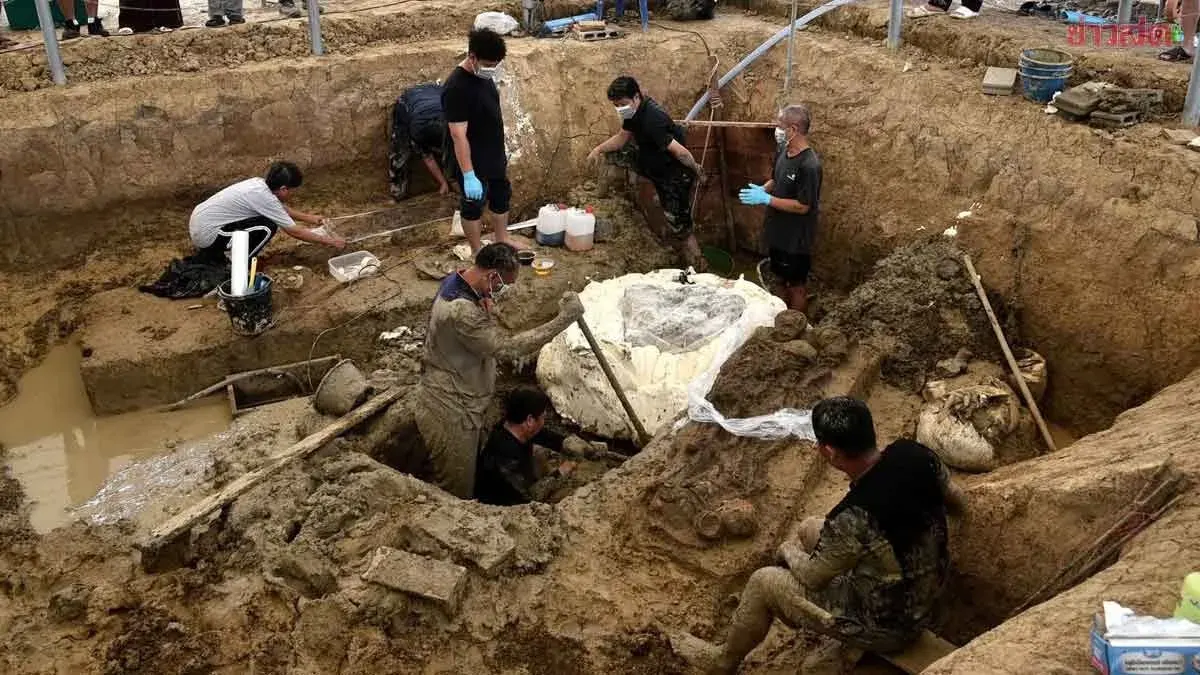
On July 15, 2569, a team of archaeologists from the Fine Arts Department's Ratchaburi office, in coordination with conservation science staff, were preparing foam blocks to protect skeletal remains at the Don Yai Thong archaeological site in Ban Don Plab, Samoe Phlue subdistrict, Ban Lad district, Phetchaburi province. The excavation, which began on July 2, has extracted skeletal remains of a human estimated to be 1,500–2,000 years old, along with four bronze drums and bovine teeth. Two gold rings were discovered on July 2 afternoon, with one bearing Brahmi script reading "Pusrakkhita," referring to one protected by the star Pushya, according to Dr. Uthen Wongsasit, an archaeologist at Silpakorn University and ancient language experts from the Fine Arts Department, who dated the script to the 5th–7th Buddhist century, or approximately 1,900–2,100 years ago.
Led by Nipa Sangkanakindr, director of the Ratchaburi Fine Arts office, and Kannika Premjai, the excavation team leader, the team has been carefully excavating soil around the first set of skeletal remains (numbered 1–4), particularly around the skull area, which is adorned with ancient brass ornaments. The team decided to raise all four skulls together as one unit, requiring coordination with conservation scientists to excavate a rectangular platform approximately 40–50 centimeters deep and apply PU foam to all four sides to prevent the soil around the skulls from fragmenting or cracking.
For the base, soil will be excavated to accommodate pre-cast concrete panels to support the foundation layer, with PU foam applied beneath to prevent cracking. Once the entire soil platform is sealed with PU foam on all sides and the base, it will be lifted from the excavation pit. The platform, including the concrete panels, is estimated to weigh approximately one ton. The excavation is challenging due to the skull unit's proximity to a second set of skeletal remains (numbered 5–8), combined with clay soil conditions and continuous groundwater seepage, making the work difficult for the team.