Loy Ruea: the boat Koh Lanta fills with its bad luck and floats out to sea
The Urak Lawoi people of Koh Lanta perform Loy Ruea twice yearly, building wooden boats filled with hair, fingernails, and offerings to symbolically cast away misfortune into the sea during a three-day full moon ceremony.
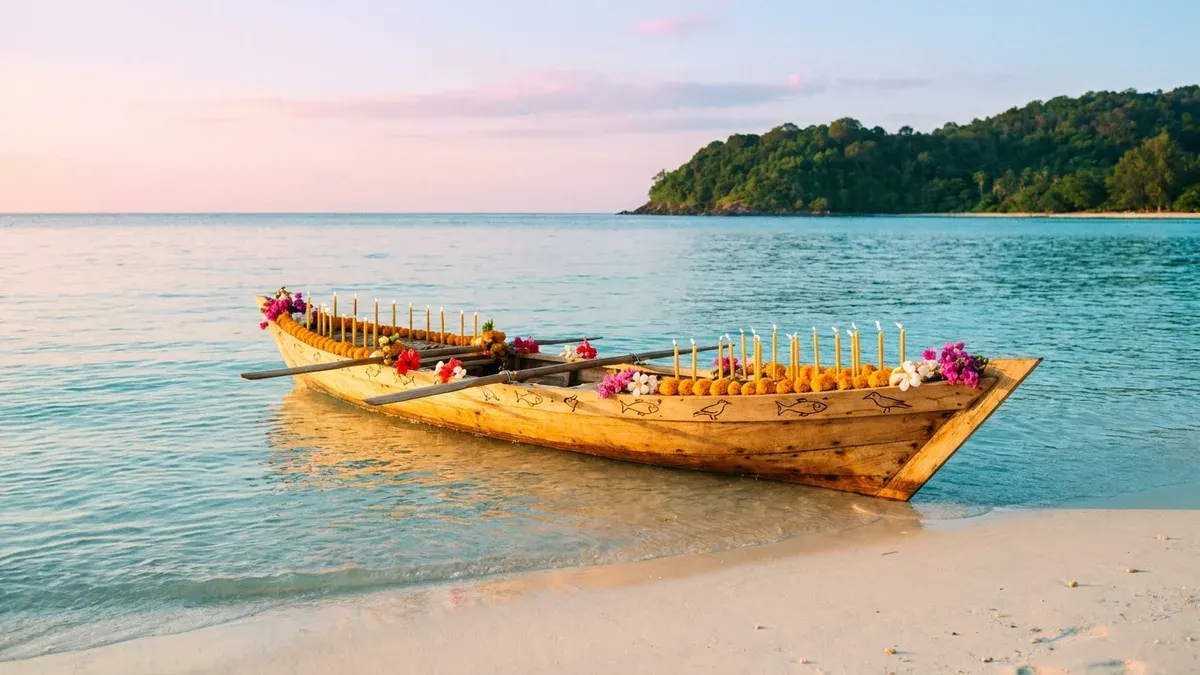
Photo: Illustration generated for Lanta News
Twice a year, on a full moon, the people who reached this coast centuries before anyone else build a small wooden boat, fill it with their bad luck, and push it out to sea.
The ceremony is called Loy Ruea in Thai, which simply means floating the boat. It belongs to the Urak Lawoi, one of the seafaring peoples usually grouped in English as Chao Ley, and it is probably the most important thing that happens on this island that almost no visitor has heard of.
Why Koh Lanta, of all places
Because this is their centre. The Urak Lawoi have their own name for Koh Lanta, Satak, and the island is described as the community's central home. Most people here are concentrated in Sangka-u, on the southeast coast, which is to say the side of the island the resorts never wanted.
They arrived more than five hundred years ago, from the Indo-Malay world, with their own language and their own beliefs. The ceremony is the part of that which is still visibly alive.
What actually happens
It runs for three days and three nights, timed to the full moons of the sixth and eleventh lunar months. Sources differ on how that lands in the Western calendar, some saying May and November and others June and November, and the dates are set village by village rather than centrally, so there is no single national date to look up.
The centrepiece is a spirit boat, built entirely by hand, roughly three metres long and divided into compartments. The prow carries carved wooden sea turtles, decorative spear-shaped weapons, and seven wooden oars.
Into it go offerings: sweets, dried food, drinking water. And then the part that makes the whole thing click into focus. People add clippings of their own hair and fingernails, standing for the misfortune and wrongdoing of the past six months. The boat is not a gift. It is a container for everything you want gone.
Elders run the preparations, because they are the ones who know how it is supposed to be done, and the food they make for it is specific: chicken curry, seven-coloured sticky rice, local sweets, candles, areca nuts and betel leaves.
The three days move in sequence. The first is a ritual at the spirit house. The second raises the masts and builds the boat, then carries it down to the beach in procession. On the third, at dawn, they take it out past the shallows and let it go.
Through the nights there is rong ngeng, the Urak Lawoi dance, led by the older members of the community. The band is not what you would guess: violin, mandolin, accordion, drums and gong. A ritual leader, the Toh Mor, an elder who holds the knowledge of how each step is performed, leads the procession and the ceremonies.
What we could not confirm, and it matters here
The detailed account above comes from documentation of the ceremony as held by Urak Lawoi communities on Lipe and Adang, in Satun province. It is the same tradition, and Koh Lanta's community holds it too, but the most detailed source we found does not describe Koh Lanta specifically.
Since every source also says the dates and details vary from village to village, we are not going to tell you that Sangka-u does it in exactly this order, on exactly these nights. We do not know that. If you are from the community, or you have been, we would like to hear how it is actually done here, and we will correct this piece.
If you want to see it
Go carefully. This is a religious ceremony and a community reckoning with its own year, not a show, even though rong ngeng is now sometimes performed for visitors. Ask locally when it falls, ask whether you are welcome, and accept the answer you get.
The one thing worth understanding before you stand on that beach: everyone around you has put something into that boat they want carried away. Watching it go is not a photo opportunity. It is the moment the year resets.
Why we wrote this
Because a Koh Lanta search brings back beaches, ferries and a French television show, and almost nothing about the people who were here first and are still here. A tradition five centuries old, practised twice a year on our own island, is a stranger thing to leave unwritten than any of it.