The tsunami signs on Koh Lanta, and what actually happened here in 2004
Koh Lanta's west coast was struck by the 2004 Indian Ocean tsunami but suffered lighter damage than other Thai destinations like Khao Lak, likely due to the island's geography and offshore reefs. Thailand has since installed a sophisticated
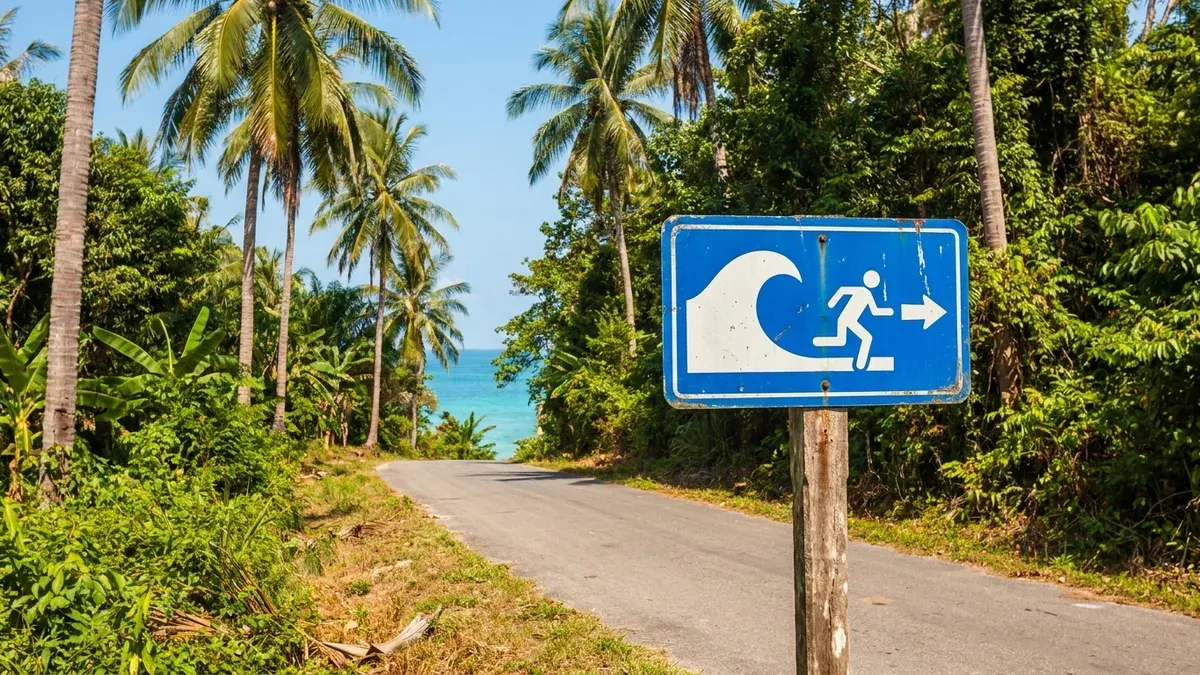
Photo: Illustration generated for Lanta News
Drive almost any road on Koh Lanta and you will pass them: blue signs with a wave and an arrow, pointing inland and uphill. Most visitors register them for a second and never ask. They are there because of one morning, twenty-two years ago.
What happened here
The earthquake off Sumatra struck early on 26 December 2004. The wave reached Thailand's south-west coast roughly two hours later, which is why so many people on the beaches that morning had no idea anything had happened at all.
On Koh Lanta the damage was on the west coast of Lanta Yai, the big island, which is the side that faces the open Andaman Sea and the side almost every resort sits on. A study of the tsunami's effects on the Lanta islands, published in Ocean & Coastal Management, records considerable losses in three villages on that coast. Most of the rebuilt west coast was back within about fifteen months.
Why Lanta was not Khao Lak
It matters to be clear about scale. Around 8,000 people died in Thailand. Phang Nga province was worst hit, and Khao Lak alone accounts for roughly 5,000 of that total. In Krabi province, the catastrophic losses were on Phi Phi, not here.
Koh Lanta was hit and it was frightening, but it was not that. Researchers looking at the island afterwards put its lighter damage down to physical luck: the shape of the island, the way the seabed shelves, and the reefs offshore, which together took energy out of the wave before it arrived. That is the explanation the studies give, and it is the one people on the island repeat.
The number we cannot give you
We wanted to tell you how many people died on Koh Lanta. We could not confirm it.
The figures in circulation do not agree with each other, and some of them are plainly inconsistent: one commonly repeated provincial total for Krabi is smaller than the confirmed death toll on Phi Phi, which is in Krabi. Rather than pick whichever number reads best, we are saying plainly that we do not have one we would stand behind. If you have documentation of the island's own toll, we would like to see it.
What the signs mean now
Thailand had no warning system in 2004. It has one now, and the Andaman coast is where it is concentrated.
Detection buoys sit out in the Andaman Sea and send readings by satellite to the National Disaster Warning Centre, which is staffed around the clock. Once a wave is forming, the arrival time can be calculated within a couple of minutes and a public alert issued inside about fifteen. On land the alert comes out of the towers you see along the coast: sirens, then a spoken announcement. Published counts of the towers vary between sources, in the region of 130 warning towers plus dozens more built as evacuation and relay points, so treat the exact number as approximate.
The announcement plays in five languages: Thai, English, Chinese, German and Japanese. That list is not arbitrary. It is a record of who was on these beaches in 2004.
What to actually do
Nothing about this should keep you off the beach. But two minutes of knowing is worth having.
If you hear the sirens, or if you feel a long earthquake, or if the sea suddenly pulls far out and exposes ground you have never seen, go inland and uphill immediately and do not wait for anyone to confirm it. The blue signs point the way, and on Lanta the high ground is never far, because the island has a spine of hills down its middle. Do not go to look at the water. Do not go back for anything.
Drills are run on this coast, so if you are here and hear an alarm and then an announcement in five languages, it may well be practice. Walk the route anyway. That is what it is for.
Why we wrote this
Because the signs are everywhere and almost nothing explains them, and because a place is entitled to have its own history told at its own scale: Koh Lanta was not the worst-hit place on this coast, and saying so is not diminishing what happened here.