Solar Power Brings Villagers Home With Safe Farming
Solar-powered greenhouses are helping farmers in Udon Thani's Kok Lam and Saengaram villages return home with stable incomes, generating over 32,000 baht annually per household through organic vegetable cultivation.
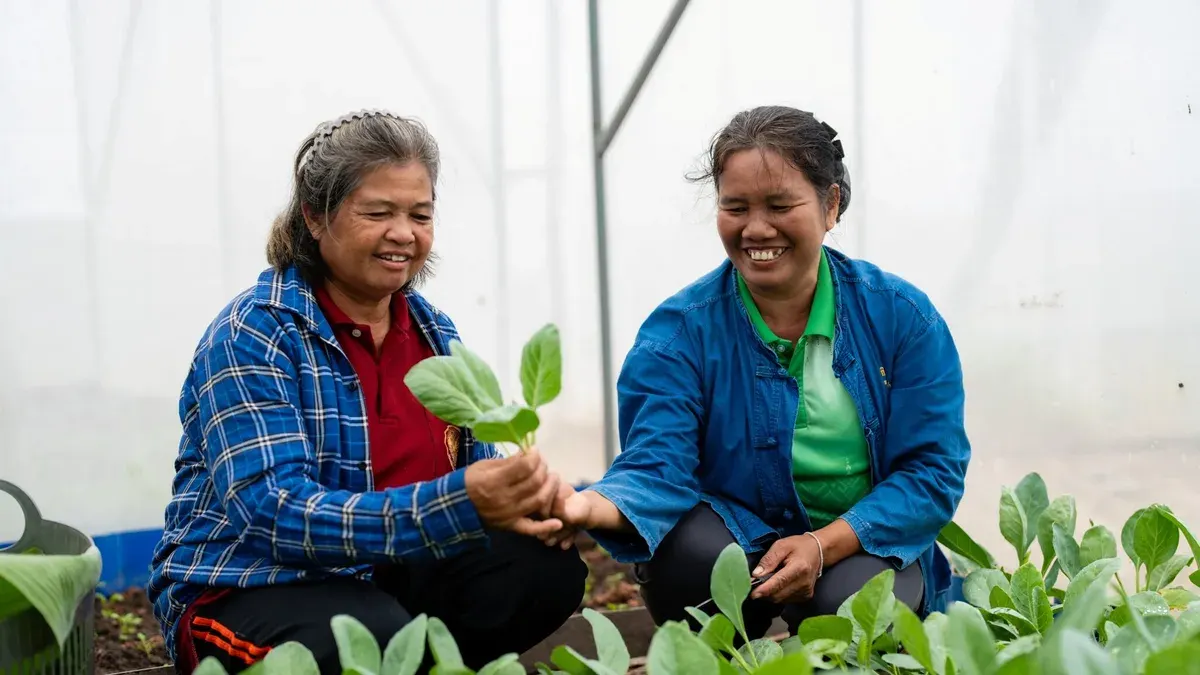
Residents of Kok Lam and Saengaram villages in Nong Wua So District, Udon Thani, have long sought stability and family unity above material wealth. Historically, after the rice harvest season ended, many villagers had to migrate to other provinces or abroad to earn income for their families, as the arid region lacked sufficient water for year-round agriculture.
Former village headman Sawet Chan-om explained how the community petitioned through royal channels and received royal initiative status to build the Huay Khluai reservoir. Initially, however, villagers could not fully utilize the water due to the lack of distribution infrastructure, forcing many to continue seeking work elsewhere. The turning point came when the Pida Thong Lang Phra Foundation, continuing the royal initiative's mission alongside partner organizations, systematically developed the reservoir and established water user groups, distribution systems, rules, and shared resource management.
Beyond water infrastructure, the foundation applied royal agricultural science principles, encouraging farmers to transition from monoculture to integrated and organic farming, particularly in greenhouse vegetable cultivation. This evolved into the Kok Lam–Saengaram Community Safe Vegetable Enterprise, which now supplies produce to local markets and modern retail chains.
Most recently, GULF Development Company Limited entered the picture by supporting 10 new vegetable greenhouses equipped with solar-powered water pumping systems, elevated tanks, water distribution pipelines, and irrigation networks serving both cultivation plots and community areas. This reduces household expenses, creates employment, and builds sustainable income streams. According to Sawet, each greenhouse cycle takes approximately 45 days and generates 4,000–5,000 baht in income, with up to eight cycles per year. This yields over 32,000 baht in additional annual income per greenhouse, enabling many families to return and settle in their birthplace with stable livelihoods.