Thailand Network Launches GCNT EXPO 2026 on Sustainable Economic Transition
Thailand's Global Compact Network is hosting EXPO 2026 in Bangkok to chart the nation's sustainable economic transition amid global crises, with government, business, and UN leaders convening to convert climate and SDG commitments into meas
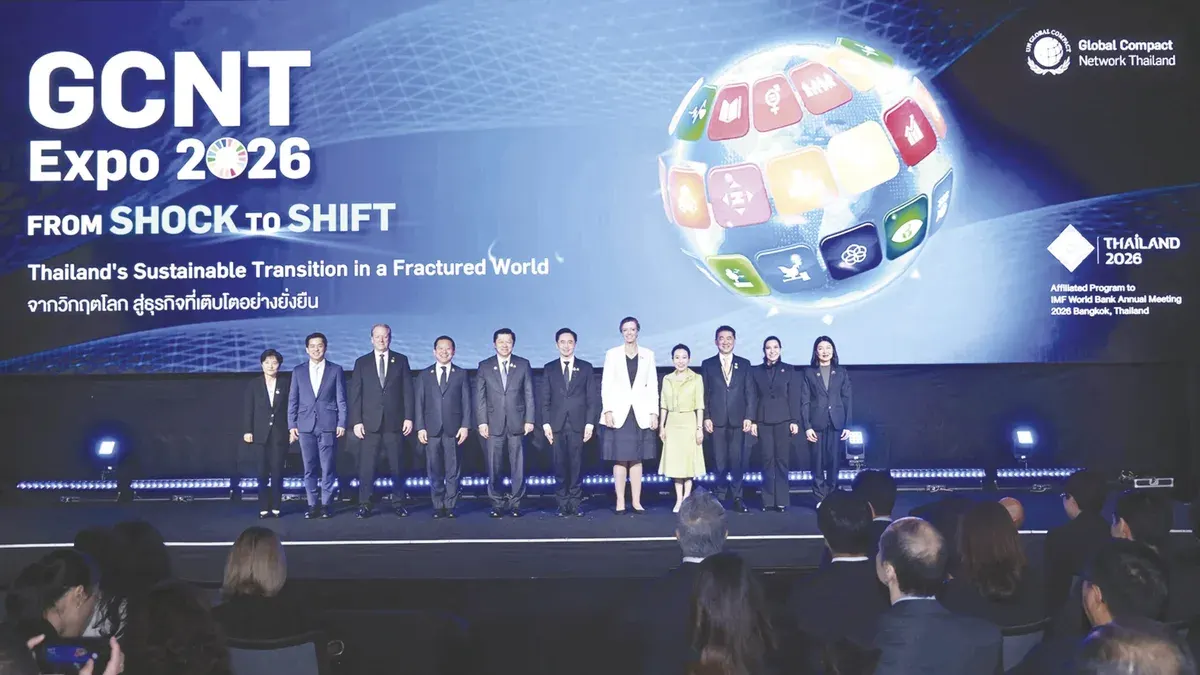
As the world faces simultaneous uncertainty from geopolitical tensions, climate change, economic volatility, and artificial intelligence disruption, the Global Compact Network Thailand (GCNT) is opening GCNT EXPO 2026 under the theme "From SHOCK To SHIFT: Thailand's Sustainable Transition in a Fractured World" from September 2-4, 2026 at True Digital Park (West) in Bangkok. The event convenes government, private sector, United Nations representatives, finance, academia, civil society, and youth to collectively determine Thailand's direction in a transformed world.
Supphachai Chearwattanakodom, chairman of GCNT and senior vice president of Charoen Pokphand Group, said the world is experiencing multiple crises simultaneously—geopolitical conflict, climate change, economic instability, and AI disruption—with real impacts on agricultural income, community security, business costs, and economic opportunity for ordinary people. Rather than allowing these shocks to paralyze the nation, Thailand must transform "shock" into a driving force for "shift," especially with less than four years remaining until 2030, the deadline for all 17 Sustainable Development Goals (SDGs).
The transition to a green economy must proceed hand-in-hand with support for workers in traditional industries and small and medium enterprises facing capital, technology, and standards constraints. The goal extends beyond reducing greenhouse gases to enabling people, businesses, and workers to grow alongside the transformation. A survey of over 100 organizations conducted by GCNT with UN Global Compact and partner networks found that Thai businesses are increasingly integrating SDGs into strategy and operations, particularly SDG 12 on responsible production and consumption. However, faster progress is needed on water, marine and terrestrial ecosystem management, reduced siloed operations, and a shift from "action" to measurable "impact."
Michaela Friberg-Storey, UN Resident Coordinator for Thailand, said crisis alone cannot drive change—it requires leadership, investment, and coordinated collaboration. She proposed three transitions Thailand must accelerate: (1) converting sustainability commitments into verifiable, measurable accountability; (2) channeling pledged capital into genuine transformative investment; and (3) extending progress from large corporations to an ecosystem where workers, SMEs, and communities participate. A critical challenge is that the world faces a $4 trillion annual funding gap to meet the SDGs. Reliance on government budgets alone is insufficient; the private sector and financial system must participate by shifting from green project-by-project approaches to transforming credit decision-making, investment criteria, and asset management across the entire economy.