Koh Lanta's rubber plantations: who taps them, at what hour, and the European rule arriving in 2027
Koh Lanta's inland rubber plantations, worked by smallholders tapping trees before dawn, produce natural latex that has sustained the island's economy for over a century. New European regulations arriving in 2027 will reshape how Thailand's
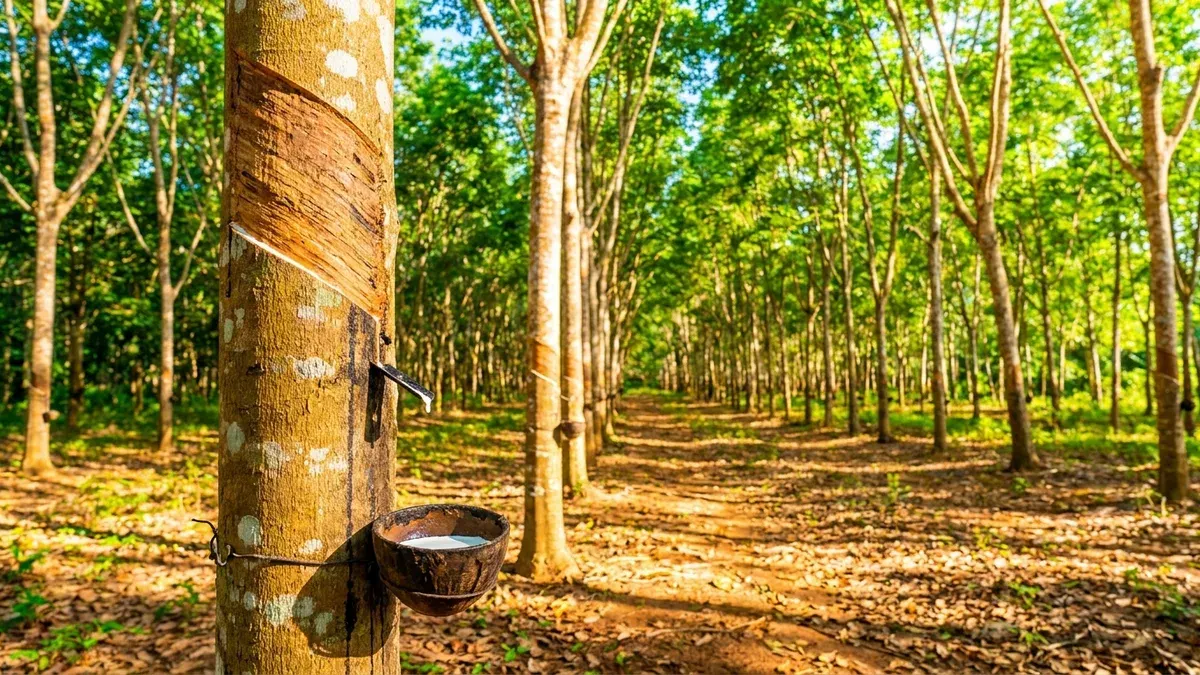
Photo: Illustration generated by Lanta News
Drive inland on Koh Lanta and the view changes fast. The beach road gives way to a single climbing lane, and then to trees in rows: slim, pale-barked, planted at even spacing, each one scored with a diagonal cut and carrying a small cup. Most visitors pass them without knowing what they are looking at. They are rubber, and on this island they were the money long before the bungalows were.
What the trees are
The tree is Hevea brasiliensis, the Para rubber tree, native to the Amazon and grown across southern Thailand since the early twentieth century. Cut the bark on a shallow diagonal and it bleeds latex, a white sap that runs for a few hours and then clots. The cut is reopened in a thin shaving the next day, and the next, working slowly down and around the trunk over years.
Thailand is the world's largest producer of natural rubber, and the industry is not the plantation-estate business people often picture. Roughly 1.7 million smallholders produce about 90% of the country's natural rubber, according to reporting by Mongabay from Krabi province in June 2026. Rubber supports roughly one quarter of Thailand's agricultural households. The chain from tree to tyre runs from millions of small farms through thousands of intermediaries into more than 200 processing factories.
On Koh Lanta the trees cover much of the mountainous interior of Lanta Yai, and a good deal of Lanta Noi, the quieter northern island most people cross without stopping. We could not find a published figure for how many rai of Koh Lanta are under rubber. Provincial and national numbers exist; an island-level number does not appear to be public, and we are not going to estimate one.
The work happens in the dark
Tapping is a night job. Latex flows best in the cool hours before dawn and slows as the day warms, so the work starts when most of the island is asleep and finishes around sunrise.
Mongabay profiled a tapper in Namgaan subdistrict on the Krabi mainland, not on Koh Lanta: Sathit Phromraksa, 59, who inherited his father's plantation. It is 1.6 hectares with 500 trees to tap, and he and his wife work it from midnight to 3:30 a.m. He has moved off heavy chemical use to biofertilisers and mechanical weeding, and sells through a local cooperative that pays him 1.5 to 3 baht per kilogram above the market price. His own estimate of how many neighbours do the same: about 10%.
That is a mainland farm, and we are flagging it rather than quietly transplanting it onto Lanta. The shape of the work is the same here, but the household is his, not an islander's.
Accounts from Koh Lanta tour operators who run morning plantation walks describe the same pre-dawn rhythm, and say the latex of roughly thirty trees makes a kilogram of dried rubber. Those are operator descriptions rather than survey data, so read them as what guides tell visitors, not as measured figures.
The European rule arriving next
The thing now bearing down on every rubber smallholder in southern Thailand was written in Brussels.
The EU Deforestation Regulation, Regulation (EU) 2023/1115, bars a list of commodities from the European market unless they can be shown not to come from land deforested after 31 December 2020. Rubber is on that list, alongside palm oil, cattle, soy, coffee, cocoa and wood, and the ban reaches derived products too.
It has been postponed twice. After a revision that entered into force in December 2025, the European Commission's own application dates are: 30 December 2026 for operators that are large and medium enterprises, and for downstream operators and traders of every size; and 30 June 2027 for operators who are natural persons and micro-enterprises, for the remaining products in scope.
Here is the part most coverage blurs, and it matters if you live here. A Thai smallholder is not the party the regulation binds. The legal duty sits with whoever first places the goods on the EU market, which is the importer in Europe. What reaches the farmer is not a European deadline but the consequence of one: the buyer needs proof, so the buyer asks the factory, the factory asks the intermediary, and the intermediary arrives at the plantation wanting a map and a document.
A map of every plot, and the people who cannot prove they own one
The practical requirement is geolocation. Every plot has to be pinned so a buyer can demonstrate where the rubber grew. The Rubber Authority of Thailand has been doing that work: in a 2024 report with the European Forest Institute it had georeferenced more than 3.1 million hectares, roughly 79% of the country's production area. It is exploring a traceability system built on producer self-declaration, modelled on the one used in timber.
The harder number is the other one. About 20% of Thailand's rubber-producing smallholders have no formal land documentation and must establish their status with the Agricultural Land Reform Office. A farm can be entirely deforestation-free and still fail the paperwork test, because the test is documentary.
There is no premium attached. A farm that does the mapping, the documents and the labour evidence gets access to the European market at the same price as before. Stefano Savi, who directs the Global Platform for Sustainable Natural Rubber, has called the shift a revolution and warned of a "compliance plateau": the farms that can comply are doing so, and the ones that cannot are where the problem stays.
Why this is a Koh Lanta story
Because the island is not only its west coast. At the 2000 census Thailand's National Statistical Office counted 23,499 people in Ko Lanta district, and 26,805 in 2010, and most of them do not live on the beach strip. Tourism is the visible economy. Rubber, fishing and palm are the other one, and they are the ones with a European compliance deadline attached.
If you take a morning walk through the plantations behind Khlong Nin or Old Town and meet someone with a tapping knife at five in the morning, that is what they are in the middle of.
What we could not verify
- How much of Koh Lanta is planted with rubber. No public island-level figure was found; provincial and national statistics exist, island ones do not appear to.
- What a Koh Lanta tapper is paid today. Rubber prices move constantly and we found no Lanta-specific figure we would stand behind.
- The "thirty trees to a kilogram" figure and the tapping hours quoted for Lanta itself come from tour operators, not from published survey data.
If you tap on Koh Lanta, or buy from people who do, and any of the above is wrong or thin, we would like to hear it and we will correct the piece.