Young Puppeteers Pass Down Ancient Thai Art
Young puppeteers at Tara Wayuput Art House are keeping Thai puppet manipulation alive through peer mentorship, with students learning that operating a single puppet requires three performers moving in perfect synchronization.
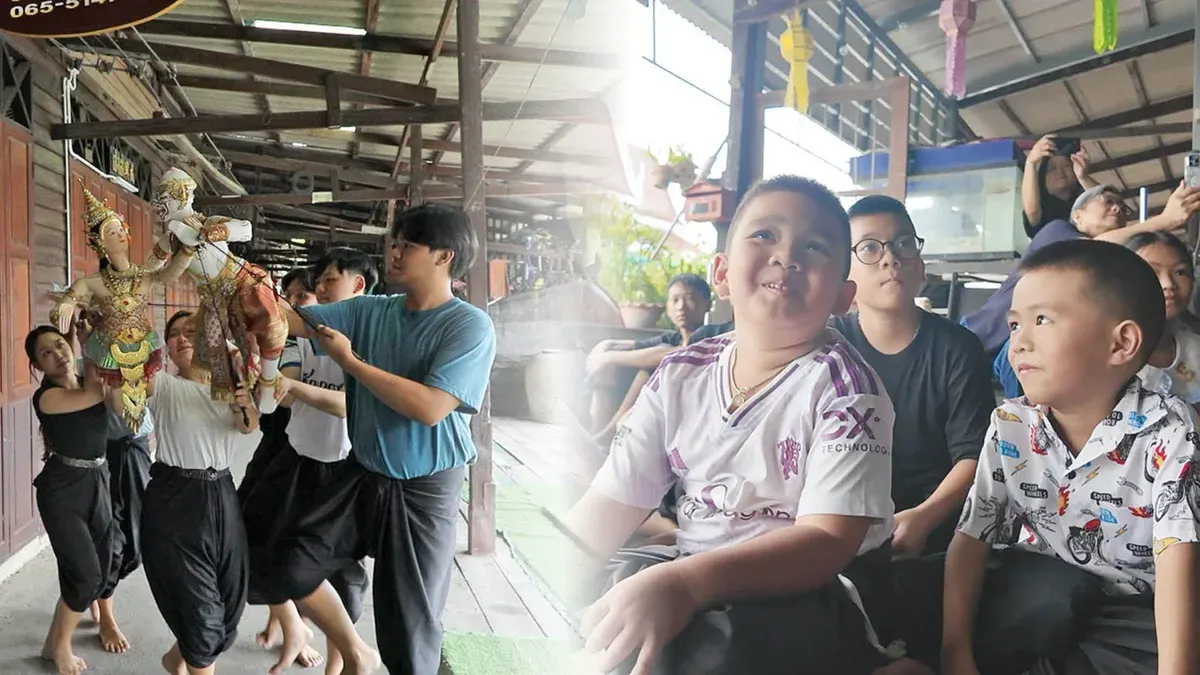
Music plays as puppet figures gradually move their limbs and dance to the rhythm at Tara Wayuput Art House along Phasi Charoen Canal. Children of different ages gather with a shared passion—some are just starting out, others have trained for years. But within this shared space, everyone remains a student and sometimes becomes a teacher. Older students naturally guide younger ones on timing, posture, and technique, creating a learning environment where knowledge passes not only from instructors but from child to child through hands-on practice.
Some senior members have worked with khon dance and puppet manipulation for over a decade, transforming from small children watching every move of their teachers into role models that younger students now watch and imitate. Yet even after years of practice, khon and puppet performance always offer new lessons to learn, as beneath every graceful movement lie countless hidden details.
Operating a single puppet requires coordination among three puppeteers, each with distinct roles and synchronized movements. Fern Nicha Lertwardanakomsesh, a member of the Wayuput Youth Puppet Ensemble, explains that the first puppeteer controls the center body, head, and left hand; the second manipulates the right hand; and the third operates the tail and legs. Even making a puppet raise its hands in greeting looks simple, but coordinating the hands, head, and body to appear graceful and lifelike requires repeated group rehearsal. "All three must train in the classical dance together, practicing until they move as one," she notes.
Puppet manipulation demands more than knowing who holds which part—all three must sense the same rhythm, watch each other's movements, and respond with just a glance. Even simple actions like the flutter of a tail are harder than they appear when attempted. New students must first master khon fundamentals and classical dance, learning body control, rhythm, and various postures through repeated practice.
This training develops not only artistic skill but also patience, observation, teamwork, and personal responsibility. No single puppeteer can bring one puppet to life alone. In an era when children face many choices and traditional Thai arts may feel distant, students come for varied reasons—some for fun, some because friends invited them, some drawn to characters and costumes, others captivated by watching the puppet gradually come alive in their hands. These simple reasons often spark lasting commitment.
Tara Wayuput Art House serves not merely as a training ground for pulling strings and manipulating puppets, but as a space for children to discover what they love, what they do well, and the direction in which they wish to grow. As one student matures from learner to mentor, what they once received is passed forward again—older students guide younger ones by hand, call out the rhythm, and stand beside them until confidence grows. Through different ages and generations learning together, the art finds its continuity.