Lanta Old Town: the island's old capital, on the coast nobody visits
Before there were roads, the sheltered east coast was where the boats came in. Old Town was the harbour, the trading post and the meeting point of three peoples. It was the district capital until the district office moved to Ko Lanta Noi at the end of the 1990s.
Almost everybody who comes to Koh Lanta stays on the west coast, on the long strip of sand between Klong Dao and Kantiang. Almost nobody goes to the island's old capital.
That is not a slight on Lanta Old Town. It is the whole point of it. The town is quiet now for exactly the reason it was busy before: it faces the wrong way.
When the sea was the road
Before there were roads on Koh Lanta, there was the water, and the east coast is the sheltered side. Old Town sits there, looking across at the mainland hills, in a spot calm enough for a wooden boat to sit out weather.
That made it the island's harbour and its commercial centre. Trading vessels working the route between Phuket, Penang and Singapore put in here, and what moved through the town was tin, charcoal and dried fish.
Look at the map with that in mind and the island reorganises itself. The beaches everyone flies in for today were the far side, the exposed side, the side facing open water. The valuable coast was the one nobody now visits.
Three arrivals, in order
The people of Old Town did not turn up all at once, and the order matters.
First the Urak Lawoi, the sea people, who have been on this island roughly five centuries and call it Satak. Then Muslim families from the Malay peninsula and Sumatra. Then, in the nineteenth century, southern Chinese arriving on the tin-mining wave that was reshaping this whole coast.
Each group is still here, and the town is one of the few places in Thailand where you can see all three layers on a single street.
The Chinese left the most visible mark
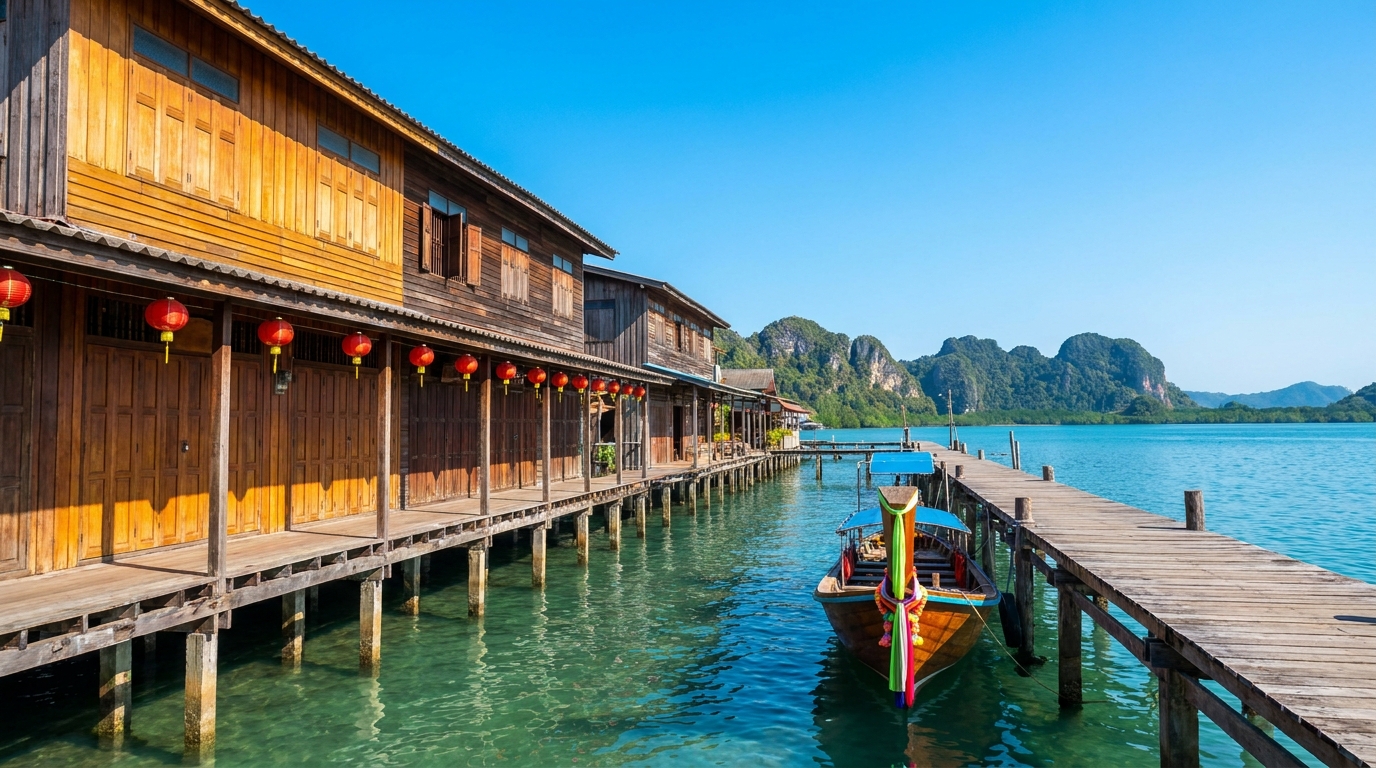
The buildings are the giveaway. The main street is lined with wooden shophouses raised on stilts over the water, teak, shuttered, some more than a hundred years old, built in the Sino-Portuguese style that runs down through Phuket and Penang.
They are not preserved as a museum piece. People live in them, and the shrines between them still smoke with incense.
What happened next is the part nobody writes down
Here is where the record thins out, and it is worth being straight about it. Old Town's rise is documented. Its decline is not, at least not in English.
What is obvious is the shape of it: at some point the land road mattered more than the sea route, tourism arrived on the west-facing beaches, and the centre of the island's economy walked across to the other coast. We could not find a reliable date for when the pier stopped being the island's main way in, and we would rather say that than invent a decade to make the sentence flow. One dated event is documented, and it is in the next section: the district office left.
If you know this history, or your family lived it, we would like to hear from you.
It was the capital until the district office moved
Old Town, Ban Si Raya, was where the district office stood from the district's early years. Thai sources we read give 1901 for that start, though one community wiki says the district status came in 2001, so treat the start date as unsettled. At the end of the 1990s the office moved to a new government centre at Ban Lang Sot, on Ko Lanta Noi, the smaller island you cross on the way in. The Ko Lanta district office's address today is Moo 1, Ko Lanta Noi subdistrict, according to the government's official information centre.
Sources differ on the year. Thai Wikipedia gives June 1998 in one place, and the Ko Lanta Noi subdistrict authority's own history, as quoted there, says the new office began operating on 13 May 1999. A government cultural-environment database also gives 1998. We found no gazette notice, so we give both years. That database says Old Town went quiet after the move and its population fell, though the market kept much of its old character.
There is still a community museum in Old Town, put together by local people rather than by an outside institution, covering the three groups who built the place. When the west coast shuts for the monsoon and the beach road empties out, the town carries on, but it no longer runs the district.
Correction, 10 November 2026: an earlier version of this article said Old Town is still the administrative seat of the whole district and listed the island's hospital among its institutions. The district office is on Ko Lanta Noi, and we could not confirm where the hospital is, so we removed both statements and rewrote this section.